By MV VacationUpdated 08 Oct, 202612 mins read 259 views
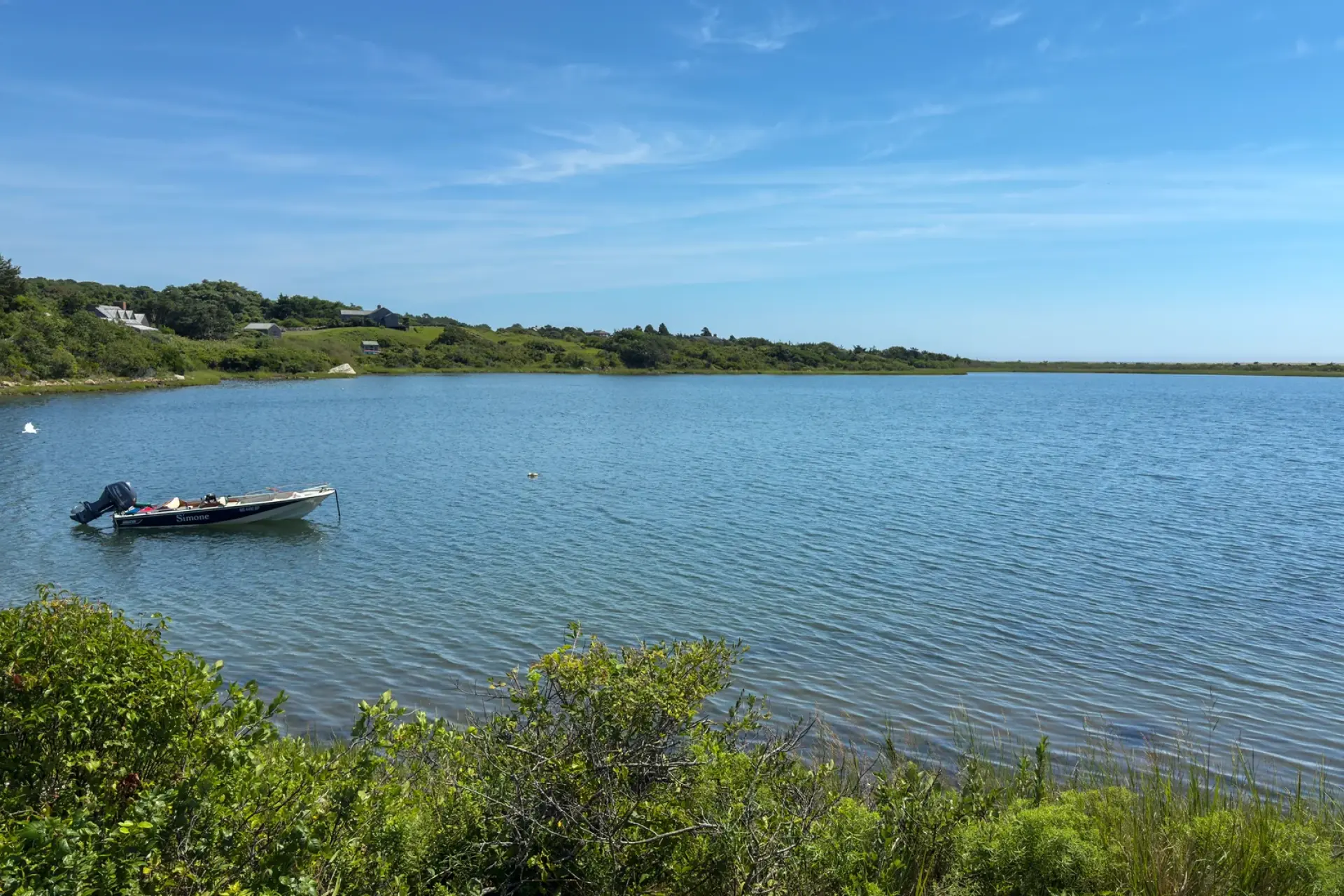
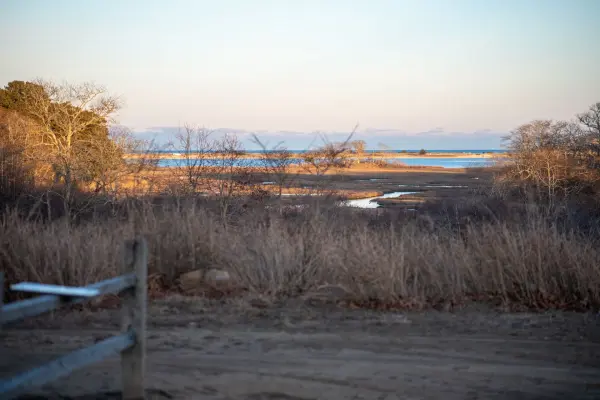
Chilmark · a pond by the shorePhoto by MV Vacation
A pond on a calm summer day, one skiff on a mooring and a low strip of beach along the far side.
Martha's Vineyard's ponds explained: the great ponds sealed behind the south-shore beach and cut open to the sea by an excavator, the salt ponds with tides and scallops, the freshwater kettle ponds, why cyanobacteria blooms turn some of them green in August and what MV Cyano's colors mean, the nitrogen under the houses, and where a visitor can swim, paddle and watch the cut.
Look at a map of Martha's Vineyard and the south shore looks like a comb: a long barrier beach with a row of ponds behind it, each one a drowned valley the glacier left, sealed off from the Atlantic by sand. The north shore has its own set, with permanent openings to the Sound. Islanders call all of them ponds. The oysters and scallops grow in them, the herring run through them, the kayaks and the summer houses face them, and the island's hardest environmental argument is about them. The sections below cover the three kinds of pond, the odd ritual of cutting a great pond open to the sea, why some of them bloom green in August and what the color codes mean, what nitrogen has to do with your rental's septic tank, and where a visitor can swim, paddle and watch it all work.
Filmed June 2023The island moves on: shops, signs and prices may differ from what you see here. The text of this guide was checked October 2026.
Tisbury Great Pond, Edgartown Great Pond and Chilmark Pond sit behind the south-shore barrier beach with no natural inlet. Their water is brackish, a mix of rain, groundwater and whatever ocean gets in when the beach is cut, and their health depends on that cut. Wild oysters, blue crabs, herring in spring and white perch.
Sengekontacket, Lagoon Pond, Lake Tashmoo, Menemsha and Nashaquitsa Ponds and Katama Bay have permanent openings, bridges or jetties, and tides. Salt water, eelgrass where it survives, bay scallops, quahogs, oyster farms, ospreys and the island’s kayaking. Sheltered enough for children, with tidal currents at the openings.
Blackwater Pond, Seth’s Pond, Mink Meadows Pond, Duarte’s and the mill ponds: glacial hollows filled with groundwater, lily pads, turtles and frogs. Seth’s has a town swimming beach; Blackwater has a Land Bank loop and a boardwalk; the rest are for looking at.
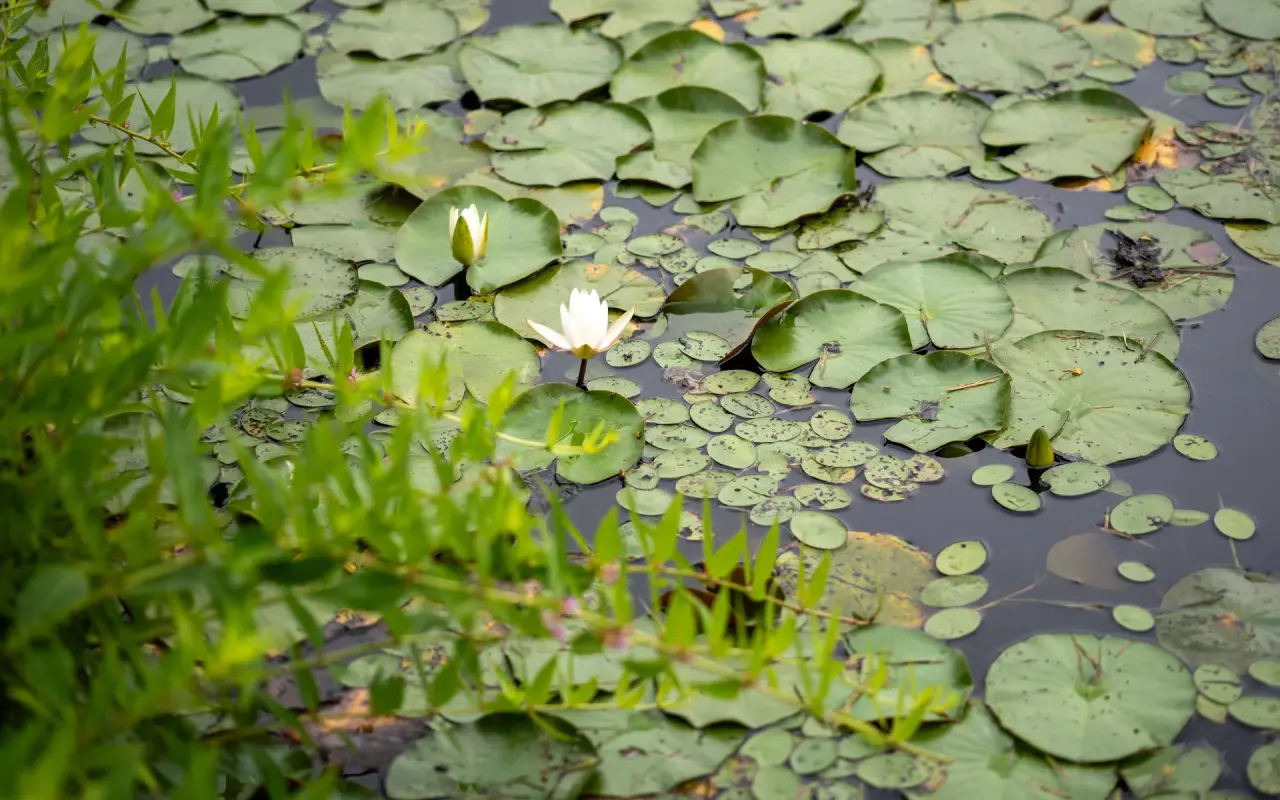
West Tisbury · a freshwater pondPhoto by MV Vacation
A water lily on a freshwater pond in West Tisbury. Blackwater Pond, a kettle pond on Land Bank land off Lambert’s Cove Road, has a short loop trail and a boardwalk, and no salt in it at all.
The cut: opening a pond to the sea
Several times a year, on a schedule set by the town shellfish constable and a committee of the pond's shoreline owners, an excavator drives onto the barrier beach and digs a trench from the pond to the surf. The pond, which has risen with winter rain, pours out through the trench in a torrent that can be heard from the parking lot; the ocean pours back in on the next tides; and for days or weeks the pond breathes salt water until the surf rebuilds the beach and seals it again. The cut does three jobs. It lowers the pond before it floods the low roads and cellars. It brings in the salinity that oysters, eelgrass and the herring need, and lets the herring in to spawn. And it flushes out the nitrogen that has built up since the last opening, which is the job that matters most in August. How long a cut stays open decides the pond's year: Edgartown Great Pond was open 92 days in 2018, 15 in 2022, 16 in 2025, and 19 days in March and April of 2026, which the Great Pond Foundation called a good start; Tisbury Great Pond is cut too, but as the 2026 summer showed, a cut alone does not keep a pond clear. The cuts are dramatic to watch and dangerous to approach: the current through a fresh opening runs like a river, the banks collapse, and the towns close the beach around it, so the view is best from a distance (the beach safety guide has more).
For beach days
The Beach Guide, free
All 20 beaches with parking, stickers, lifeguards and dog rules, plus a one-page card for the beach bag. Free with the island letter, together with three more island guides.
One-click unsubscribe, and we never share your email.
Why the ponds bloom, and what the colors mean
Cyanobacteria, the blue-green algae, live in every pond and become a problem when three things line up: warm water, low salinity (below about 15 parts per thousand) and an excess of nitrogen and phosphorus. Then they bloom into green scum, clumps and paint-like streaks along the shore, and some strains produce toxins that damage the liver or the nervous system and can kill a dog that drinks the water. Since 2021 the island's boards of health and the Great Pond Foundation have run MV Cyano, a monitoring program that samples eight ponds routinely, fourteen in 2025, at eleven stations, and posts a color for each: green for no bloom, yellow for an alert, orange for a bloom watch, red for a bloom advisory. The 2025 season brought the most blooms since the program began, with record concentrations at Edgartown Great Pond, routine early-summer blooms and high toxin readings at Chilmark Pond, one of the highest liver-toxin readings the lab had ever seen at Squibnocket Pond in June, and repeated blooms at Mink Meadows Pond in Tisbury. The 2026 summer told a different story: Tisbury Great Pond and Chilmark Pond bloomed again by late July, while Edgartown Great Pond stayed clear at every station, which the foundation credited to the spring cut and to eelgrass that had come back and was eating the nutrients before the algae could.
For a visitor it comes down to a few habits: checking the current colors at greatpondfoundation.org/mvcyano before a pond swim or paddle, staying out of water with green clumps, scum or streaks (and out entirely near an open cut), rinsing in fresh water afterwards, and keeping dogs away from a pond under advisory, because they drink it and lick their coats. A red pond is not closed to boats, but it is no place to swim or let a dog drink.
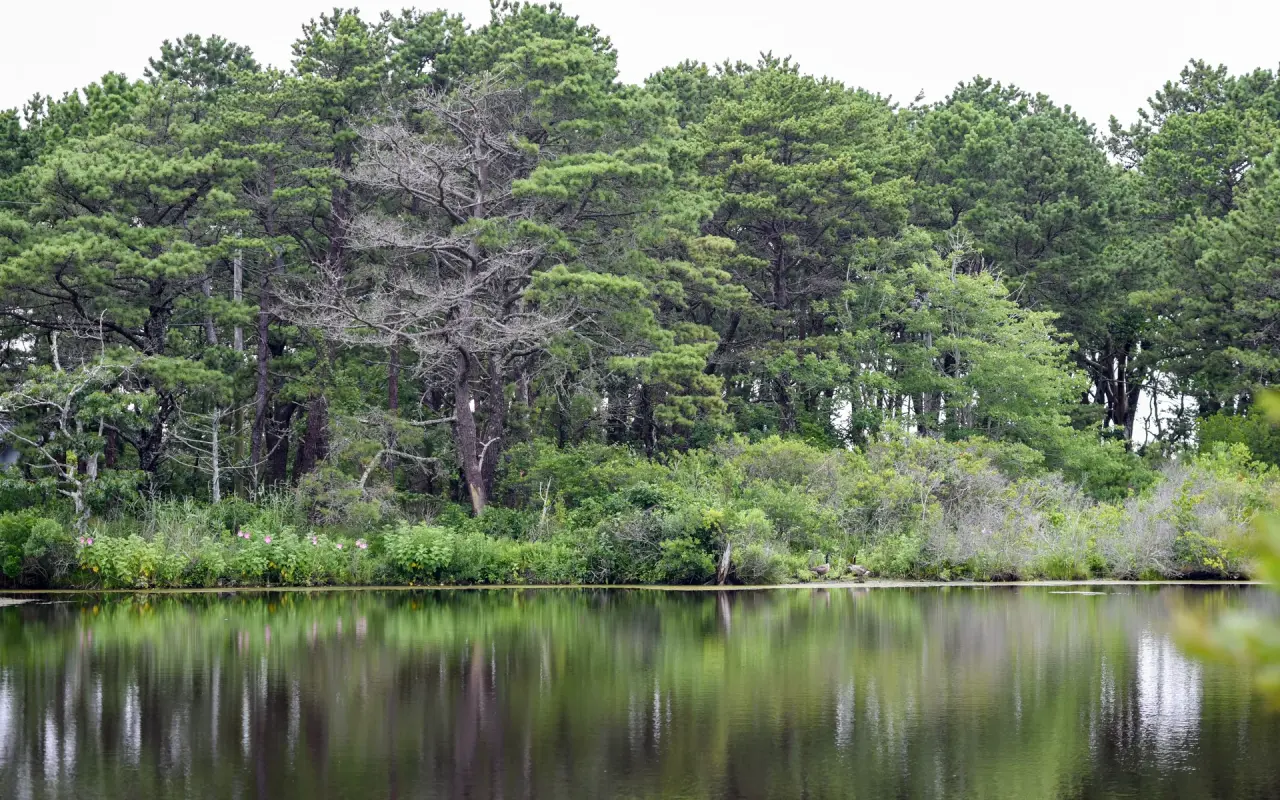
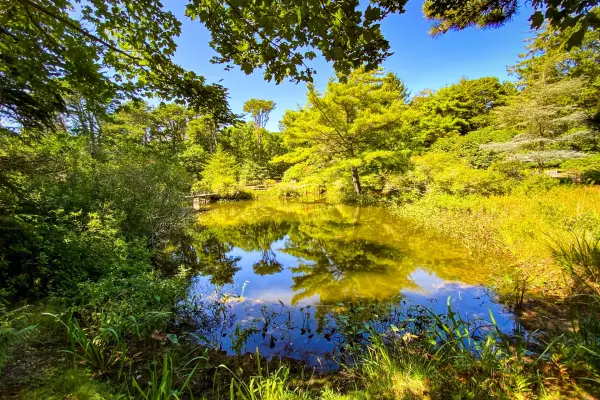
Vineyard Haven · a pond in the pinesPhoto by MV Vacation
A still pond under the pines, glass-calm on a gray day. The island has dozens like it; most have no name a visitor would know and no path to their edge.
Nitrogen: the argument under the houses
The nitrogen that feeds the blooms comes, on this island, mostly from under the houses: the state's standard Title 5 septic systems, which were designed to remove bacteria and do nothing about nitrogen, plus lawn fertilizer and road runoff. Every summer house on a pond watershed adds its share, and the Massachusetts Estuaries Project set each pond a target: Lagoon Pond needs its nitrogen load cut by about 35 percent, Lake Tashmoo by 32, Menemsha Pond by 47, Tisbury Great Pond by 19. The eelgrass that scallops and young fish need is the first casualty, and there is little of it left in Katama Bay or Sengekontacket. The fixes are expensive and slow: Edgartown's wastewater treatment plant is the single biggest thing that town has done for its great pond; Tisbury's State Road sewer project and its 2023 Lake Tashmoo watershed plan are the down-island equivalents; nitrogen-removing septic systems are required on some new houses; and the Shellfish Group's eelgrass restoration and the oysters themselves, which filter water and take nitrogen out with them when they are harvested, are the biological half. Our shellfish guide explains that side. None of it is fast, which is why the cut on the beach still matters every spring.
The largest of the great ponds. The Trustees’ Long Point refuge gives you the ocean beach and the pond together (reserve a summer parking pass; kayak rentals on the pond); the Land Bank’s Sepiessa Point on Tiah’s Cove Road is the quiet way in, with a launch and a walk. Wild oysters in winter under West Tisbury and Chilmark rules.
Seen from the south-shore beaches and the road ends; the Great Pond Foundation runs the science from its edge. In 2026 eelgrass grew in Lyle’s Bay for the first time since 2023.
Beautiful, and prone to blooms. Residents and Chilmark renters reach it through Lucy Vincent Beach in season; everyone can see it from South Road. A sonic buoy has been used since 2025 to knock down late-summer blooms.
The visitor’s pond: the Felix Neck sanctuary on its western shore with naturalist kayak tours, the State Beach barrier on its eastern side, ospreys on every pole. Closed to shellfishing each summer for bacteria; open to paddling all year.
Between Vineyard Haven and Oak Bluffs, with the solar shellfish hatchery on its Tisbury shore, a herring run at the top, kayak rentals at the bridge and the bay-scallop opening in autumn.
A salt pond with a jettied opening to the Sound, a small town beach at the channel, moorings, and a history of golf, baseball and ice boats on the panels at the old waterworks. Our Tashmoo post has it.
Two connected salt ponds behind Menemsha, oyster farms on the bottom, and a paddle from the Menemsha landing that our kayaking guide calls the best on the island. Herring Creek, which the Wampanoag Tribe manages on tribal land, carries alewives and blueback herring out of Menemsha Pond into Squibnocket Pond from mid-March into June; the tribe counts them past an underwater camera on a seasonal weir.
Blackwater Pond loop off Lambert’s Cove Road (Land Bank, free, lily pads, a bridge); Seth’s Pond on the same road, a West Tisbury swimming beach that closes for bacteria after rain more often than for algae.
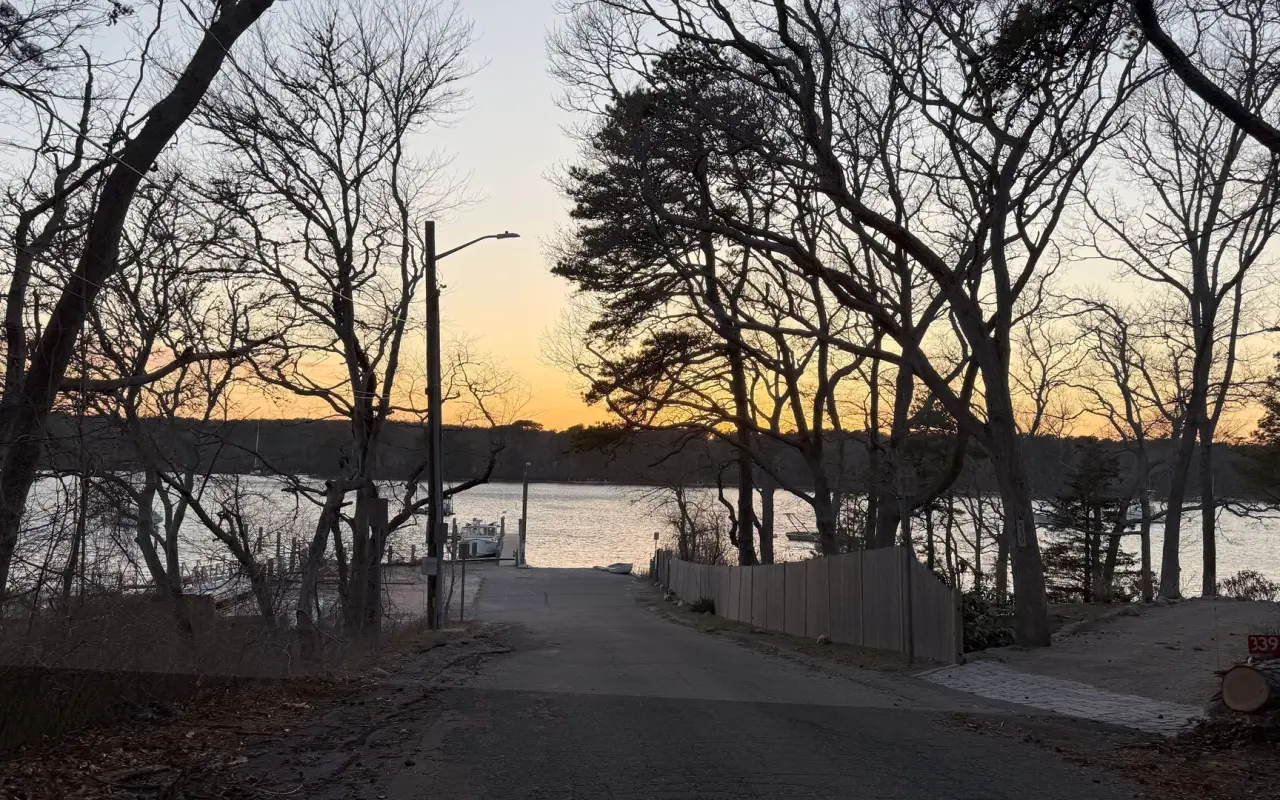
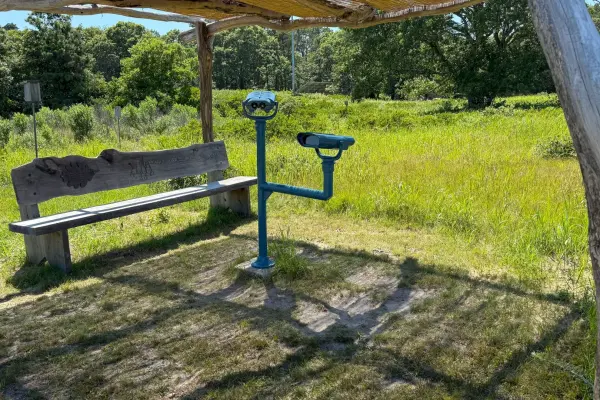
Vineyard Haven · the Tashmoo landing at duskPhoto by MV Vacation
The road down to the Lake Tashmoo landing at sunset, the pond flat beyond the trees. A salt pond with a permanent opening: no cut needed, tides twice a day, and a nitrogen target of its own.
What a visitor can do
Before a pond swim, the color is worth a look: MV Cyano’s map at the Great Pond Foundation, and the state beach dashboard for bacteria; the beach safety guide links both.
The salt ponds are the island’s best flat water for paddling; the kayaking guide has launches, rentals and the wind warning. Boats with heads use the harbor pump-outs, never the pond.
Renting on a pond comes with a few easy habits: no fertilizer on the lawn, nothing down the drain that should not go there, and the septic pumped on schedule; the rental guide explains why the lease mentions the septic system.
Shellfishing takes a town permit: quahogs year-round, scallops from October, oysters in winter, each under the town’s rules; the shellfish guide has the permits and the seasons.
A pond cut is best watched from the top of the beach, behind the town’s tape, because the trench banks move and the current in it is fast.
Dogs are safest on a leash and out of green water, since bloom water can kill a dog that drinks it.
October is a lovely time to see them, with scallopers on the Lagoon, ospreys leaving, the great ponds full and clear after the autumn cut, and the Milky Way over the water.
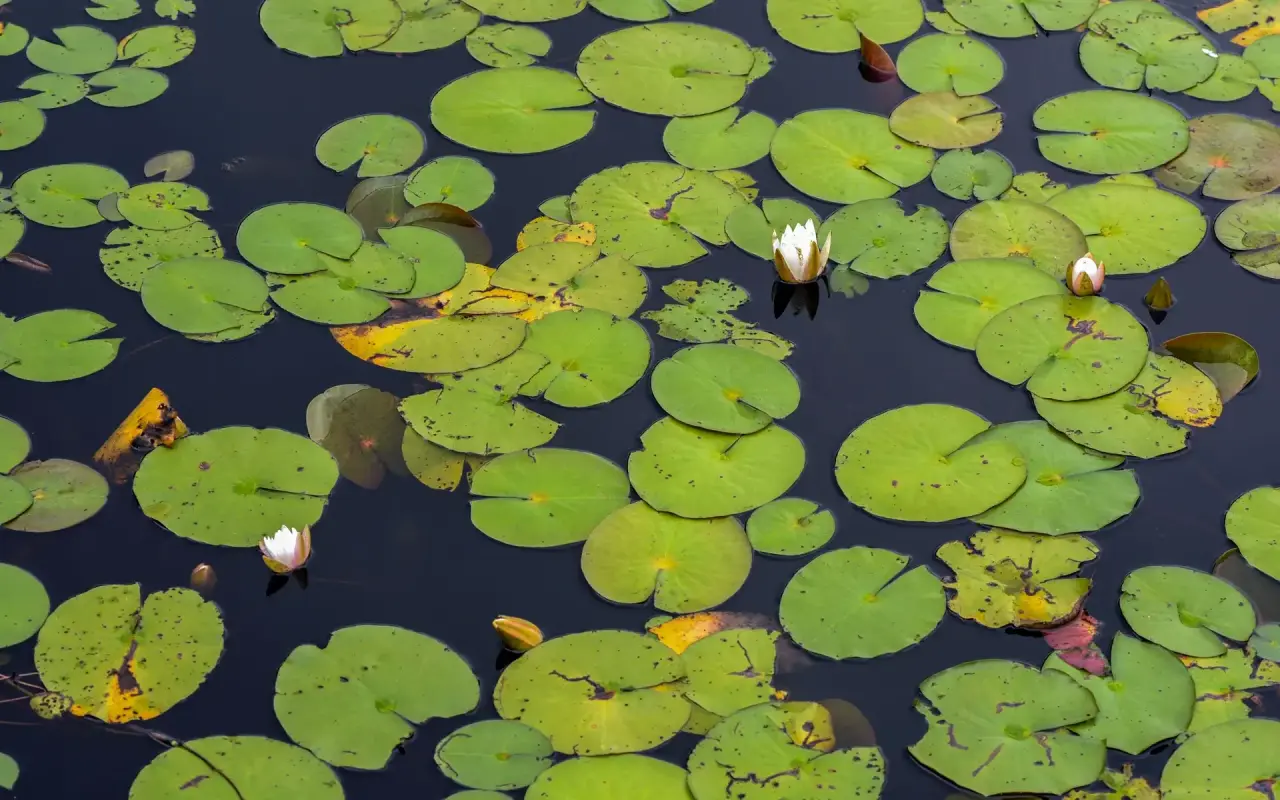
West Tisbury · water liliesPhoto by MV Vacation
Water lilies on a freshwater pond in West Tisbury, white flowers just opening among the pads.
At a glance
Great ponds
Tisbury, Edgartown, Chilmark: sealed by the beach, cut open by the towns several times a year
Blackwater, Seth’s, Mink Meadows and the mill ponds
Blooms
Cyanobacteria in warm, low-salt, high-nitrogen water; MV Cyano colors green, yellow, orange, red since 2021
2026 so far
Tisbury Great Pond and Chilmark Pond bloomed by late July; Edgartown Great Pond clear
Nitrogen targets
Lagoon minus 35 percent, Tashmoo minus 32, Menemsha minus 47, Tisbury Great Pond minus 19
Visitor access
Long Point and Sepiessa (Tisbury Great Pond), Felix Neck and State Beach (Sengekontacket), Tashmoo town beach, Blackwater loop, Seth’s Pond beach
How we checked this
The cut history of Edgartown Great Pond, the 2026 opening, the eelgrass return and the wastewater plant are from the Vineyard Gazette of April 19, 2026; the 2025 MV Cyano results and the 2026 blooms from the Gazette of May 12 and July 28, 2026; the program’s structure, color codes and health guidance from the Great Pond Foundation’s cyanobacteria resource; the nitrogen reduction targets from the Massachusetts Estuaries Project as reported by the Gazette and the Martha’s Vineyard Commission; the Tashmoo watershed plan from the Martha’s Vineyard Times of July 2023. Pond conditions change with every rainstorm, and the foundation’s map is the only current source. The photographs are ours.
Frequently Asked Questions
What is a great pond?
Tisbury Great Pond, Edgartown Great Pond and Chilmark Pond: drowned glacial valleys behind the south-shore barrier beach with no natural inlet. Their water is brackish and their health depends on being cut open to the sea by an excavator several times a year.
What is the cut?
On a schedule set by the town shellfish constable and the pond’s shoreline owners, an excavator digs a trench from the pond to the surf. The pond pours out, the ocean pours back in on the next tides, and for days or weeks the pond breathes salt water until the surf seals the beach again.
Which ponds are open to the sea?
The salt ponds: Sengekontacket, Lagoon Pond, Lake Tashmoo, Menemsha and Nashaquitsa Ponds and Katama Bay, with permanent openings, bridges or jetties and real tides. They hold bay scallops, quahogs, oyster farms, ospreys and most of the island’s kayaking.
Can I swim in a pond?
Seth’s Pond in West Tisbury has a town swimming beach and Blackwater Pond has a Land Bank loop and boardwalk; the other kettle ponds are for looking at. The salt ponds are sheltered enough for children, though the openings have tidal currents.
Why do some ponds turn green in August?
Cyanobacteria bloom when warm water, low salinity and too much nitrogen and phosphorus line up, and much of that nitrogen comes from septic systems. MV Cyano posts a color for each monitored pond, worth checking before any pond swim and especially after heavy rain.
Island tip of the dayShoppingNo. 31 of 86New tip at midnight, island time
The Chappy Ferry costs $5/person round-trip and $17 for a car with driver. Cards work at the Edgartown-side kiosk; bring cash for the boat itself.
Useful?
More on
Four free downloads · 2026 editions
Four island guides, in your inbox
The Beach Guide (all 20 beaches decoded), The Vineyard in the Fall, the season date by date, Where to Stay, every town and price band, and What It Really Costs, the 2026 budget line by line. All four PDFs free, plus a short island letter when there is something worth telling. No schedule, no spam.
No spam, unsubscribe in one click. Want a look first? See what you get.
First email ever from us? Give it a minute, and peek in spam once.
Disclaimer: The information in this article is provided for general guidance only and was accurate at the time of writing. Beach conditions, hours, prices, lifeguard schedules, ferry fares, and business operations change frequently and without notice. Ocean swimming carries inherent risks including rip currents, undertow, and cold water shock. Always verify current conditions with official local sources before your visit. MV Vacation assumes no responsibility for any loss, injury, or inconvenience resulting from the use of this information. Swim only where lifeguards are on duty, supervise children at all times near water, and follow all posted safety signs.
A guide to Martha's Vineyard, written on the island: beaches, dining, events and island living. We write down what we know about the island so your trip goes the way you hoped.
Shellfishing on Martha's Vineyard town by town: what each of the six towns charges a visitor for a permit and what it covers, where to buy it, weekly limits and sizes, the 2026 to 2027 bay scallop dates published so far, how to check storm and rain closures, and keeping the catch safe to eat.
Where Martha's Vineyard's oysters, bay scallops and quahogs come from: the public solar hatchery on Lagoon Pond that turned fifty in 2026, the dozen oyster farms in Katama Bay, Menemsha Pond and Vineyard Sound, the wild beds in the great ponds, the autumn scallop season and its limits, visitor shellfish permits by town, why rain closes a pond, and where to eat them.
Mytoi, the Japanese garden on Chappaquiddick: how to get there on the Chappy ferry, the 15-car lot, hours and admission by season, the pond and bridge, birch walk and camellia dell, the story of Hugh Jones, Mary Wakeman and the rebuild after Hurricane Bob, rules, accessibility and when to go.
Felix Neck Wildlife Sanctuary in Edgartown: the four easy trails and what each passes, the ospreys, the butterfly garden, hours and admission, Mass Audubon's kayak tours and prices, accessibility, the Wampanoag and Smith-farm history, and when to go.
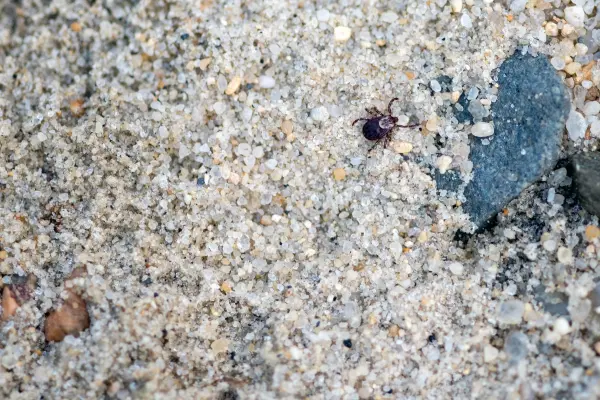
Updated for 2026: Martha's Vineyard tick safety. Four species now including the Asian longhorned tick, 2025 alpha-gal figures, the island's new tick clinics, prevention, removal, and the latest Lyme vaccine news.
Subscribe
The free island library · 2026
One short island letter, and all four guides to start
Beach reports, events worth a day, ferry heads-ups. Sent when there is something worth telling. The Beach Guide, The Vineyard in the Fall, Where to Stay and What It Really Costs arrive with your welcome email.
The Beach Guide, The Vineyard in the Fall, Where to Stay and What It Really Costs. No spam, one-click unsubscribe.
We use cookies for trip planning, site stats and ads, including ads based on your browsing. To opt out, turn on Global Privacy Control in your browser. Cookie policy
These cookies are essential for the website to function properly.
These cookies help us understand how visitors interact with the website.
These cookies are used to deliver personalized advertisements.