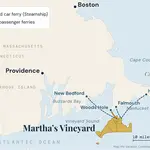
Travel advisorySteamship Authority travel advisory · Gale Warning on the ferry waters until Fri 2 PMGusty winds are forecast for Cape Cod and the Islands that will have the potential to cause cancellations on both the Hyannis-Nantucket and Woods Hole-Martha's Vineyard routes through Thursday. We are waiving change and cancellation fees for travel scheduled for Tuesday, October 20, through Thursday, October 22.Steamship Authority · checked 5:00 PM ET
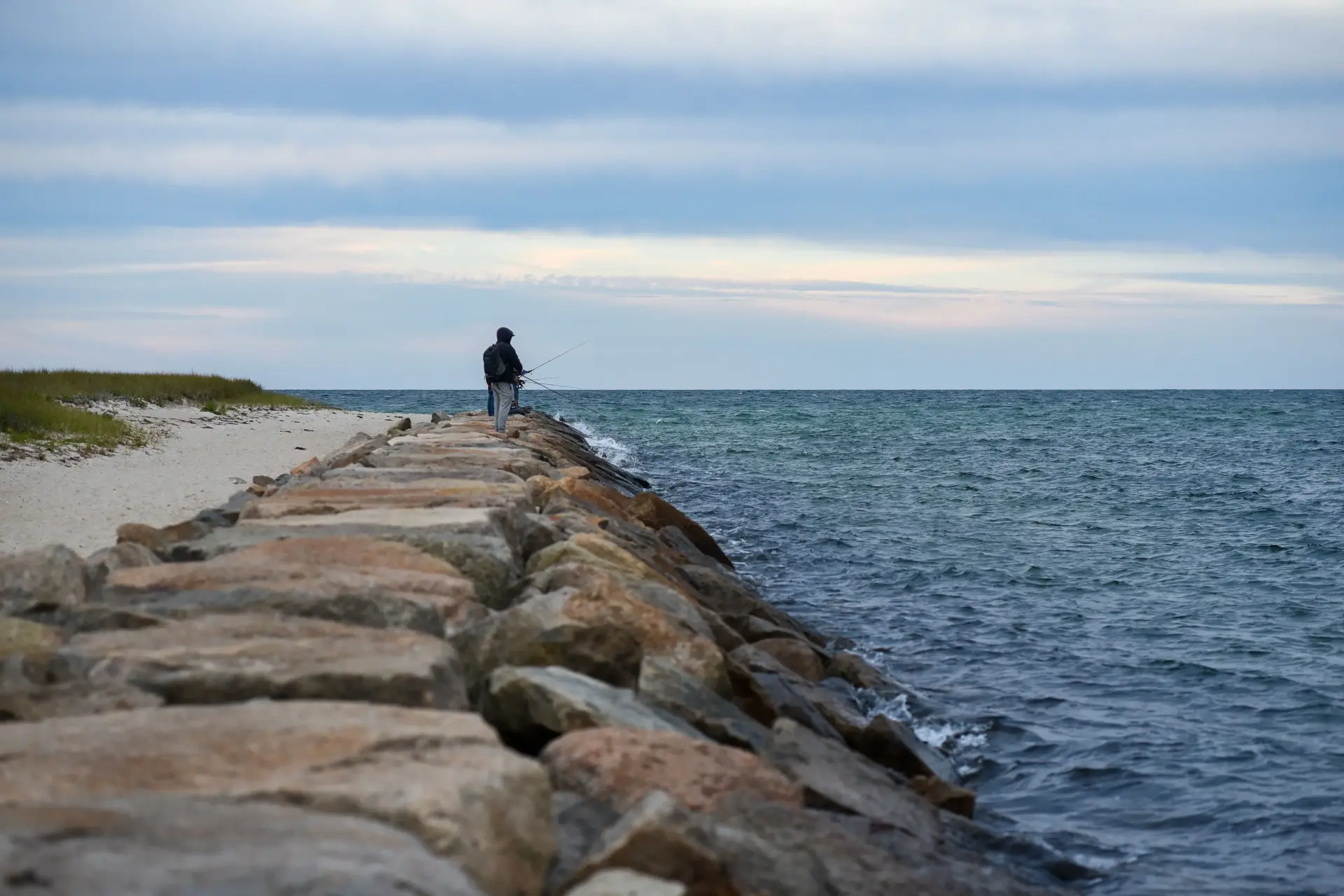
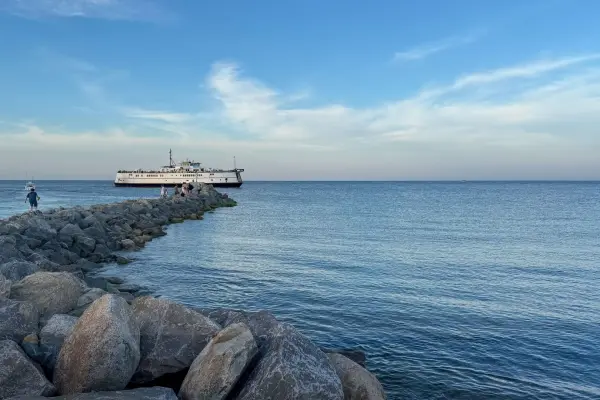
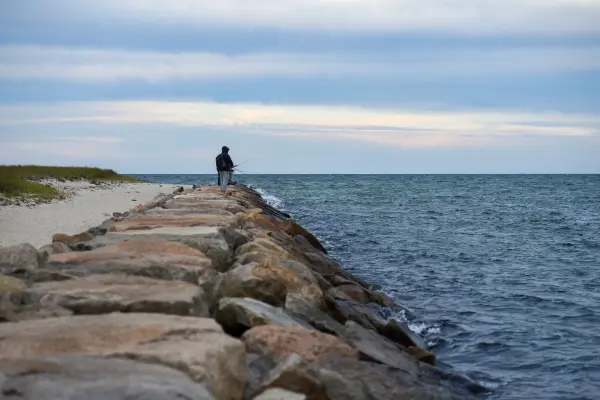
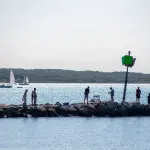
An angler casting from far out on a stone jetty in Oak Bluffs, a light chop on the water. Anyone 16 or older fishing from shore needs the $10 state permit, keeper or not.
Every rule a visiting angler needs on Martha's Vineyard, checked October 2, 2026: who needs the $10 Massachusetts saltwater permit, freshwater and tuna permits, 2026 size and bag limits by species, what you can keep this month, the Derby, beach-driving permits, pier rules and Aquinnah parking.
If you are 16 or older and you fish anywhere in Martha’s Vineyard’s salt water, from the Oak Bluffs pier, a Menemsha jetty or a kayak on Sengekontacket, you need a Massachusetts recreational saltwater fishing permit, even if every fish goes back. It costs $10, it is free (but still required) from age 60, and it runs to the end of the calendar year. Step aboard a party boat or a charter and the boat’s permit covers you instead. That is the easy part. The rest is what a visiting angler runs into here: the 2026 size and bag limits for the fish people catch around the island, the striped bass rules, the ponds, tuna, the Derby, the beach-driving permits, the town piers and the Aquinnah parking that catches people out. For where and when to fish, start with our Martha’s Vineyard fishing guide and the fishing page; this one is the rulebook. Everything was checked on October 2, 2026 against the state Division of Marine Fisheries, NOAA Fisheries, MassWildlife, the Derby’s own rules, the Trustees and the towns. Rules change, sometimes in mid-season, so every table carries its check date and a link to the official page, and where something is not published we say so.
The same price for visitors and residents; free from age 60, but you still need one. Bought online it comes to $13.38 with fees, and every permit expires on December 31.
KIDS No permit under 16
A child under 16 needs no saltwater permit, and a child under 15 needs no freshwater license. The size and bag limits still apply to anything they keep.
PARTY BOATS AND CHARTERS The boat covers you
Anglers on a permitted for-hire boat need no permit of their own, and the bluefish limit on board is 7 instead of 5.
STRIPED BASS One fish, 28 to under 31 inches
Open all year, measured with the tail squeezed. Natural bait means an inline circle hook; no gaffs, no stringers. Nothing changed for 2026.
OCTOBER AND NOVEMBER Sea bass closes after October 14
From October 15 tautog goes up to 5 a day and every black sea bass goes back; fluke has been closed since September 23. Bluefish 5, bonito and false albacore 5 combined.
Finfish rules are state rules; shellfish rules are town rules, and every town sells its own permit. Lobster takes a separate state permit.
The saltwater permit: who needs one
The Massachusetts recreational saltwater fishing permit is the one license almost every visiting angler needs. The Division of Marine Fisheries (DMF) requires it for anyone 16 or older fishing in salt water, “whether you plan to keep any fish or not,” and that covers the shore, a private boat, a kayak and an evening of squid jigging off a dock. It costs $10, the same for residents and non-residents. Anglers 60 and older pay nothing but still need the permit. Every permit expires on December 31, so the $10 buys the same thing in October as it does in May: the rest of the calendar year.
How to buy
Getting the permit
ONLINE
Through the state’s MassFishHunt site, linked from the DMF permit page. A $10 permit costs $13.38 online ($2.75 handling plus a $0.63 convenience fee); a free 60-plus permit costs $2.89. It is issued the same day, and you can print it again whenever you need to.
IN PERSON OR BY MAIL
From a license agent, such as a bait and tackle shop or a town clerk (the state keeps a map of agents), or by mailing the paper application. Agents charge the same $2.75 handling fee plus a small agent fee of up to $1.50.
CARRY IT
On paper or on your phone. DMF requires you to have a copy of your current permit with you whenever you fish in salt water.
WHO IS EXEMPT
Anglers under 16; anglers fishing on a permitted for-hire boat, such as a party boat or a charter; people who meet the state’s definition of a disabled person (Chapter 19C of the General Laws); and non-residents holding a valid Connecticut, New Hampshire or Rhode Island saltwater permit, with some residency conditions.
OTHER STATES
A Massachusetts permit also lets you fish the salt water of Maine and Rhode Island, of New Hampshire if you do not live there, and of Connecticut if you live in Massachusetts.
WHERE THE $10 GOES
Into a state fund for saltwater fishing. The Oak Bluffs Fishing Pier, a $1.2 million project that opened in 2014, was paid for with permit fees.
For a fall trip
The Vineyard in the Fall, free
The Derby, the beaches that open to everyone and what closes when, date by date. Free with the island letter, together with our other three island guides.
One-click unsubscribe, and we never share your email.
Party boats and charters: the boat covers you
Anglers aboard a permitted for-hire boat, from a party boat to a private charter, are exempt from the saltwater permit. A few limits are a little different on board: a for-hire trip allows 7 bluefish instead of 5 and 40 scup a day in May and June, and because you are on a boat, the fluke minimum is the boat size, 17.5 inches. The island’s walk-on party boat is the Skipper, at Slip 74 in Oak Bluffs Harbor (508-693-1238). The boat’s own page, last updated in August 2025, lists $100 a person with licenses and bait included, and one trip a day in spring and fall, 9 AM to 1 PM. It has not published a 2026 price or a last sailing date (the 2025 season ended in early October), so a call before you go is worth it. For a private charter, our Martha’s Vineyard fishing guide lists the island’s charter captains.
Fresh water: a separate license from age 15
Freshwater fishing is run by MassWildlife, not DMF, and the ponds need a freshwater fishing license from age 15, one year younger than the saltwater permit. For a visitor the 2026 price is $50 for the year or $30.50 for three days, plus the $5 Wildlands Conservation Stamp that goes on every non-resident license and the online fees; non-residents aged 15 to 17 pay $8. Residents pay $40, and nothing from 15 to 17 or from 70. The license runs from the day you buy it to December 31, and it is sold on the same MassFishHunt site (MassWildlife’s license page).
The statewide limits are simple: 6 trout a day, no more than 3 of them brook, brown or tiger trout; 5 largemouth or smallmouth bass at 12 inches; 5 chain pickerel at 15 inches. In spring 2026 the state stocked rainbow trout in Mill Pond, Seth’s Pond, Duarte’s Pond and Upper Lagoon Pond, the Vineyard Gazette reported, and the Land Bank’s Blackwater Pond Reservation in West Tisbury has a fishing pier. Ice House Pond is a swimming spot and is not on the Land Bank’s fishing list. White perch from the brackish great ponds fall under the saltwater table: 8 inches, 25 a day. Our guide to the island’s ponds has the rest.
Tuna, sharks and other big fish: the federal permit
Tuna, billfish and swordfish are managed by NOAA Fisheries, not the state, and sharks fall under both federal and state rules. To fish for them recreationally from your own boat, the boat needs a federal HMS Angling permit, renewed every year; the application fee on NOAA’s permit page is $24, and sharks need an extra shark endorsement (a short video and an identification quiz). Charter boats carry their own federal Charter/Headboat permit. Bluefin limits change during the season by notice. On October 2 NOAA listed a private-boat limit of two bluefin per boat per day between 27 and 73 inches (curved fork length), only one of them 47 inches or longer, and every trophy category, 73 inches and up, closed for the rest of 2026. Check NOAA’s bluefin status page on the day you go.
For sharks in state waters the limit is one per trip at 54 inches (78 for hammerheads), many species are protected and go straight back, a baited line set for sharks needs circle hooks, and nobody fishing from shore anywhere in Massachusetts may put a baited hook out with a drone, a remote-control boat or a bait cannon.
The 2026 limits, species by species
These are the state rules for the fish visitors catch around the island, from DMF’s recreational regulations table (last updated April 28, 2026) and its 2026 angler poster. Sizes are total length unless noted. When a season is closed, everything goes back.
Species
Open season
Minimum size
Daily limit
Striped bass
All year
28" to less than 31"
1
Bluefish
All year
None
5 (7 on a for-hire boat)
Bonito and false albacore
All year
16" curved fork length
5, both species combined
Black sea bass
May 16–Aug 31 Sep 1–Oct 14
16"
4 2
Scup
May 1–Dec 31
9.5" from shore, 11" from a boat
30 (40 on a for-hire boat May 1–Jun 30)
Fluke (summer flounder)
May 24–Sep 23
16.5" from shore, 17.5" from a boat
5
Tautog
Apr 1–Dec 31
16"; only one a day over 21"
3 Apr–May, 1 Jun–Jul, 3 Aug 1–Oct 14, 5 Oct 15–Dec 31
Longfin squid
All year
None
No limit
Cod south of Cape Cod
Closed
n/a
None may be kept
Checked October 2, 2026 against the DMF table and the 2026 angler and for-hire posters; squid from NOAA Fisheries.
Striped bass: the slot, the circle hook and the rest
One fish a day, at least 28 inches and less than 31, all year. DMF’s June 2026 reminder says none of the striped bass rules are new this year: the coastwide commission chose no new cuts in October 2025, and the next full stock assessment is due in 2027. Measure in a straight line, not over the curve, from the tip of the snout with the mouth closed to the end of the tail with the tail squeezed together. If you fish with whole or cut natural bait you need an inline circle hook; the one exception is natural bait on an artificial lure, such as a tube and worm, and a striper caught any other way goes straight back. Gaffing a striper is prohibited, and so is keeping one alive on a stringer or in a live well, swapping a kept fish for a bigger one, or throwing back a dead legal-size fish. A keeper stays whole (gutted, bled and scaled is fine) until you are ashore with your gear stowed; then you may fillet it, two fillets per angler, each with two square inches of skin left on until you get home or to where you are staying. Spearfishing for stripers is not allowed.
Bluefish, bonito and false albacore
Bluefish went up on May 8, 2026, from 3 to 5 a day from shore or a private boat and from 5 to 7 on a for-hire boat, with no minimum size. Bonito and false albacore, the fall fish of the Derby, share a 5-fish limit, both species combined, with a 16-inch minimum measured as curved fork length: along the curve of the body from the tip of the upper jaw to the fork of the tail. That rule dates from 2025 and applies in state waters. This fall’s run produced a big one: a 19.91-pound false albacore caught from a boat and weighed at the Derby on September 17, which the Derby lists as both a Derby record and a Massachusetts record.
Black sea bass, scup and fluke: shore or boat matters
Black sea bass are open May 16 to October 14 at 16 inches: 4 a day to August 31, then 2 a day from September 1. From October 15 every sea bass goes back. On a boat they may be filleted but not skinned, two fillets per fish. Scup are open May 1 to December 31, 30 a day, with a smaller minimum from shore (9.5 inches) than from a boat (11 inches), and a private boat with five or more anglers is capped at 150 scup. Fluke follow the same shore-or-boat split, 16.5 inches from shore and 17.5 from a boat, 5 a day, but their season ran May 24 to September 23 and is closed now.
Beach Road · a bridge over the inletPhoto by MV Vacation
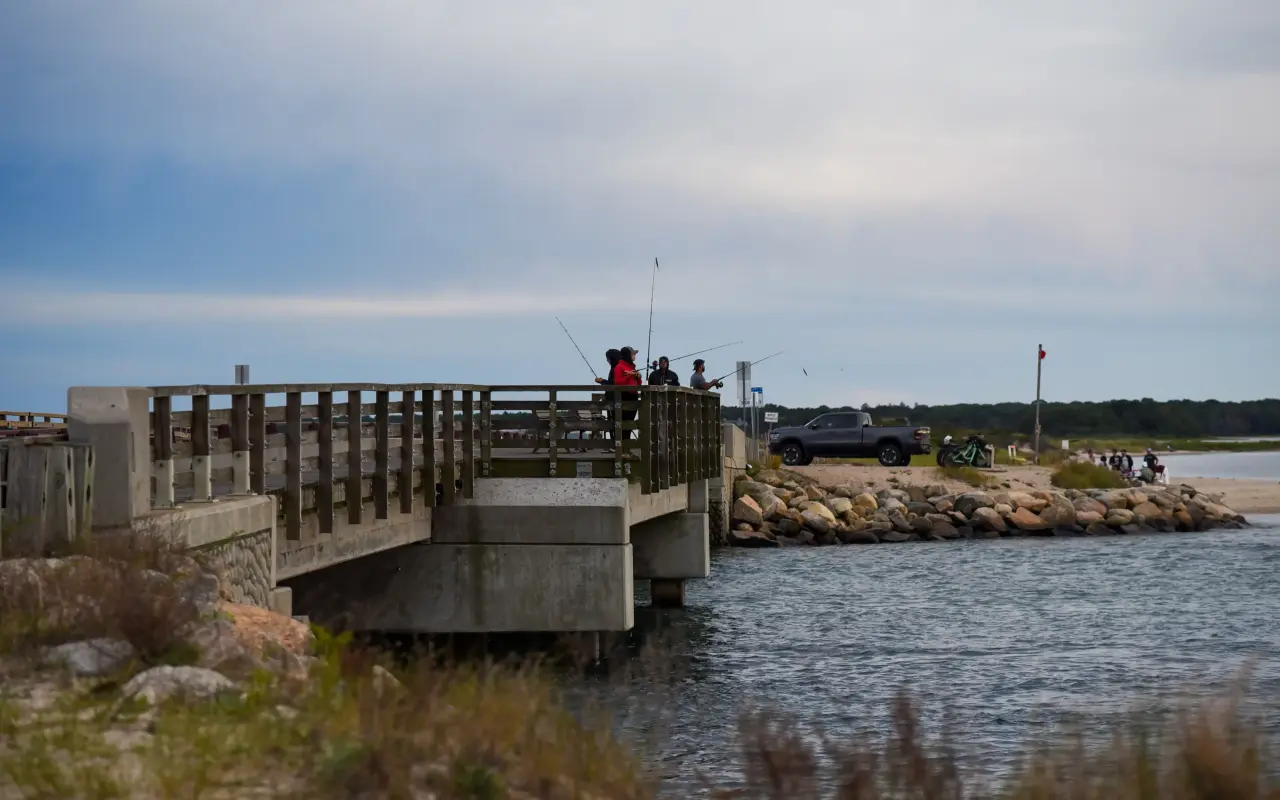
Anglers with their rods out at the rail of a Beach Road bridge, where Sengekontacket Pond runs into Nantucket Sound, on a gray day. A bridge or a jetty counts as shore, so the shore minimums apply: 9.5 inches for scup, and 16.5 for fluke in season.
Tautog
Tautog are open April 1 to December 31 with a 16-inch minimum, and one fish a day may be over 21 inches. The daily limit moves with the season: 3 in April and May, 1 in June and July, 3 from August 1 to October 14, and 5 from October 15 to December 31. Anglers on a private boat share a 10-fish limit for the whole boat.
Squid, cod and the rest
Longfin squid have no recreational possession limit, NOAA Fisheries says, but jigging them in Massachusetts still takes the saltwater permit at 16 and over; on the island they are a spring catch, jigged under the dock lights in May. Cod are closed south of Cape Cod, which takes in all the waters around the Vineyard. For anything not listed here, DMF’s full table has it.
What can I keep this month?
The quick version for the rest of 2026, fishing from shore or a private boat (on a for-hire boat, make that 7 bluefish).
Species
Oct 1–14
Oct 15–31
November
Striped bass, 28" to under 31"
1
1
1
Bluefish
5
5
5
Bonito and false albacore, 16" fork length
5 combined
5 combined
5 combined
Black sea bass, 16"
2
Closed
Closed
Scup, 9.5" shore, 11" boat
30
30
30
Tautog, 16"
3
5
5
Fluke
Closed
Closed
Closed
Longfin squid
No limit
No limit
No limit
Cod
Closed
Closed
Closed
And for the rest of the year, if the 2027 rules match 2026:
When
What opens or changes
Still closed
December
Scup (30) and tautog (5) stay open to December 31; stripers, bluefish, bonito and albies are open all year
Black sea bass, fluke, cod
January–March
Stripers, bluefish, bonito and albies are open on paper, though most of the fish have left for the winter; winter flounder opens March 1 (12", 2 a day)
Tautog, scup, black sea bass, fluke, cod
April
Tautog opens April 1 (3 a day)
Scup, black sea bass, fluke, cod
May
Scup May 1 (30); black sea bass May 16 (4); fluke May 24 (5)
Cod
June–July
Everything above is open; tautog drops to 1 a day
Cod
August
Tautog back to 3 a day from August 1
Cod
September
Black sea bass drops to 2 a day from September 1; fluke closes after September 23
Cod
Checked October 2, 2026, against the 2026 rules. Next year’s limits may differ: in 2026 DMF announced its changes on April 23 and dated its posters May 1, so look at the DMF table before a spring trip.
What is legal and what is biting are different questions. Going by the Derby’s weigh-ins, On The Water’s October 1 report called this “an excellent season for bonito on the Vineyard, especially for shore anglers,” and Kismet Outfitters in Edgartown lists its bonito and false albacore season as August to November.
The Derby, in brief
The Martha’s Vineyard Striped Bass and Bluefish Derby runs from 12:01 AM on Sunday, September 13 to 9 PM on Saturday, October 17, 2026, and despite its name it is a contest for bluefish, bonito and false albacore. The 2026 rules brochure marks striped bass “Suspended for 2026 Derby,” as they have been every year since the committee voted the species out in January 2020. A few of its rules matter even if you are only fishing alongside it:
State law still applies. The Derby requires its anglers to follow state and federal rules, so you still need the $10 permit and you still fish to the state limits. The Derby adds its own minimums for the scale: bluefish 22 inches, bonito 21, false albacore 25, measured from the tip of the lower jaw to the tip of the tail.
Registration happens in person. Online pre-registration is payment only; your entry is complete when you pick up your badge and rules at a registration point: Larry’s, Coop’s and Kismet Outfitters in Edgartown, Dick’s in Oak Bluffs, Menemsha Texaco in Chilmark, or Derby headquarters. A fish caught before that does not count. Adults pay $70 (seniors $45), and juniors 9 to 14 and mini-juniors 4 to 8 pay $25.
The weigh station is at the Edgartown Jr. Yacht Club, 8 to 10 AM and 7 to 9 PM every day of the Derby. Fish have to be weighed within 14 hours of being caught and kept on ice; bleeding is fine, gutting is not.
Each badge allows four false albacore for the whole Derby, counting every albie you bring to the scale, short ones included.
The Derby bans yo-yoing, drones, mechanized bait or lure launchers and snagged fish. From the strike, the angler hooks and fights the fish without anyone else touching the rod, reel or line.
Catch and release counts too: the Roberto Germani Memorial catch-and-release awards are for bluefish, bonito and false albacore released alive at Derby minimum length and entered online within 14 hours. There is no striped bass category there either.
Menemsha · Basin RoadPhoto by MV Vacation
Menemsha Texaco at 60 Basin Road, with its order window, its be-kind sign and its pumps. The state’s saltwater guide lists it among the island’s bait and tackle shops, and it is one of the Derby’s registration points.
The awards are on Sunday, October 18 at Farm Neck Golf Club in Oak Bluffs, and everyone is invited. Our Derby visitor’s guide covers watching the weigh-ins, entering for a day and the awards.
Driving on the beach to fish: two permits, both with caveats
Cape Poge, Leland Beach and Wasque: the Trustees
The Trustees of Reservations sells the Chappaquiddick over-sand vehicle permits online only, after a required driving-training video, and you collect the permit at the Mytoi Gatehouse with your registration and the gear every vehicle must carry: a shovel, a full-size spare, a tire gauge, a board, a tow strap and a jack. Tires go down to 15 psi, and only at Mytoi. The 2025–26 prices were $250 for the “Cape Poge & Wasque” permit and $380 for “All Over,” each with a Trustees membership included; the 2026–27 prices appear only inside the purchase page. Wampanoag tribal members get the permit free.
What the permit buys has shrunk. Wasque is closed to vehicles because of erosion at the south end of Leland Beach, driving on Cape Poge ends at the Jetties, and since a Land Court injunction on September 28, 2026, permit holders may not drive the trails north of a private lot just past Tom’s Neck until the case is tried in March 2027. Walking and boat access stay open, and the judge wrote that nothing in the order limits the public’s right to fish within the intertidal area. There are no refunds for closures. The rules are on the Trustees’ permit page; the day’s beach status goes out on their Martha’s Vineyard Facebook page and by text alert (text TTORBEACHALERTSOSV to 888-313-1761).
Chappaquiddick · Dike BridgePhoto by MV Vacation
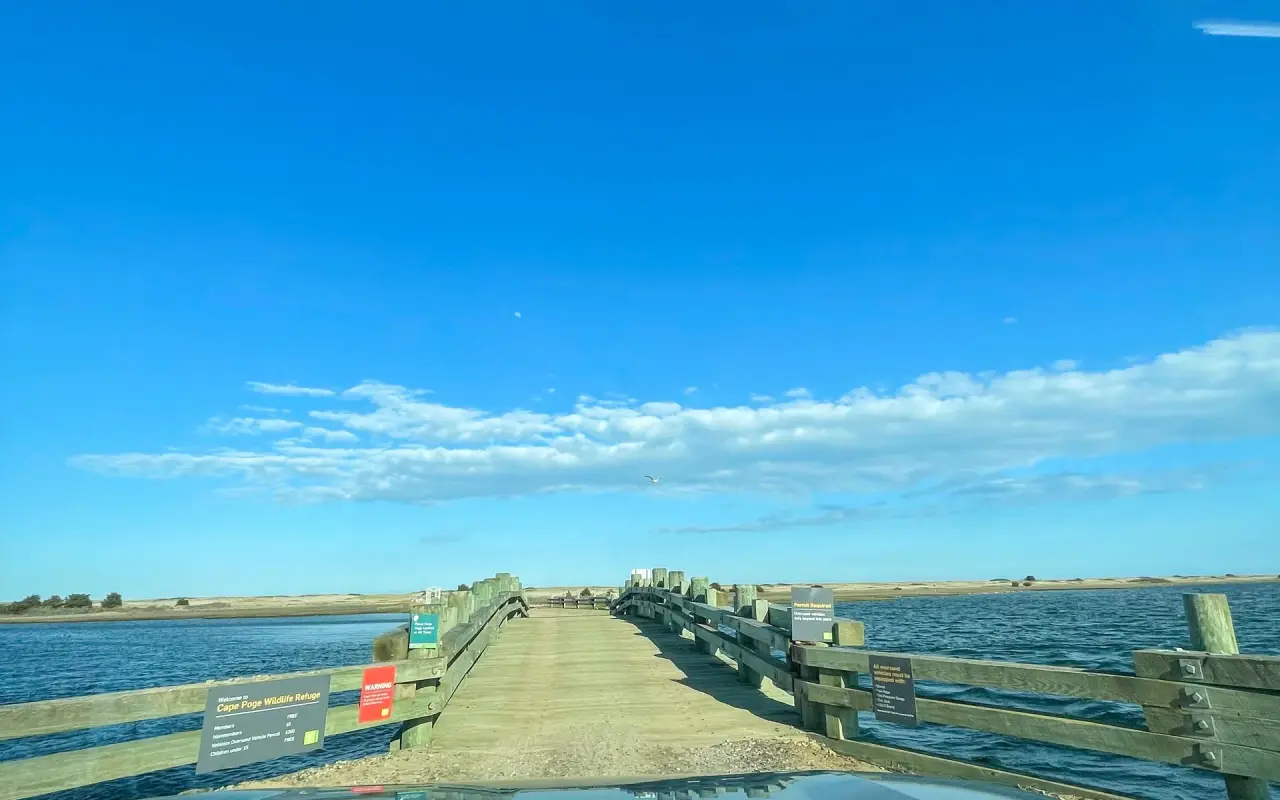
Driving onto Dike Bridge, Cape Poge ahead. The Trustees’ signs on the rails read “Permit Required: oversand vehicles only beyond this point” and list the gear every vehicle must carry, from a shovel and tow rope to a tire gauge, jack and board. The prices on the welcome board are from an earlier season.
You need no permit to fish there on foot. Walkers and cyclists get into Wasque free; a car pays $25 to park for non-members ($15 for Trustees Family members, free with an over-sand permit) from Memorial Day to mid-October, 9 to 5, and nothing outside those hours. Trustees properties close from 10 PM to 5 AM except to surfcasters. If you are fishing Chappy after dark, the On Time ferry runs until midnight through Saturday, October 17; from October 18 it stops at 10 PM, with one more crossing between 11:00 and 11:15 PM. Our Wasque and Cape Poge page has the ways in.
Norton Point: the Town of Edgartown
Norton Point belongs to Dukes County and has been run by the Town of Edgartown since April 2023. On October 2 the Edgartown Parks page read: “Norton Point is open for OSV access daily from 9AM until dark.” Stickers are sold online through the town and picked up at the trailer at the Left Fork; the town does not show the 2026 price outside the checkout. The breach that opened on January 1, 2026 cut Norton Point off from Chappaquiddick, so there is no driving from Katama to Wasque this year, and the town warns that the breach is very dangerous to swim. Questions go to Edgartown Parks at 508-627-6145.
Norton Point · February 2026Photo by MV Vacation
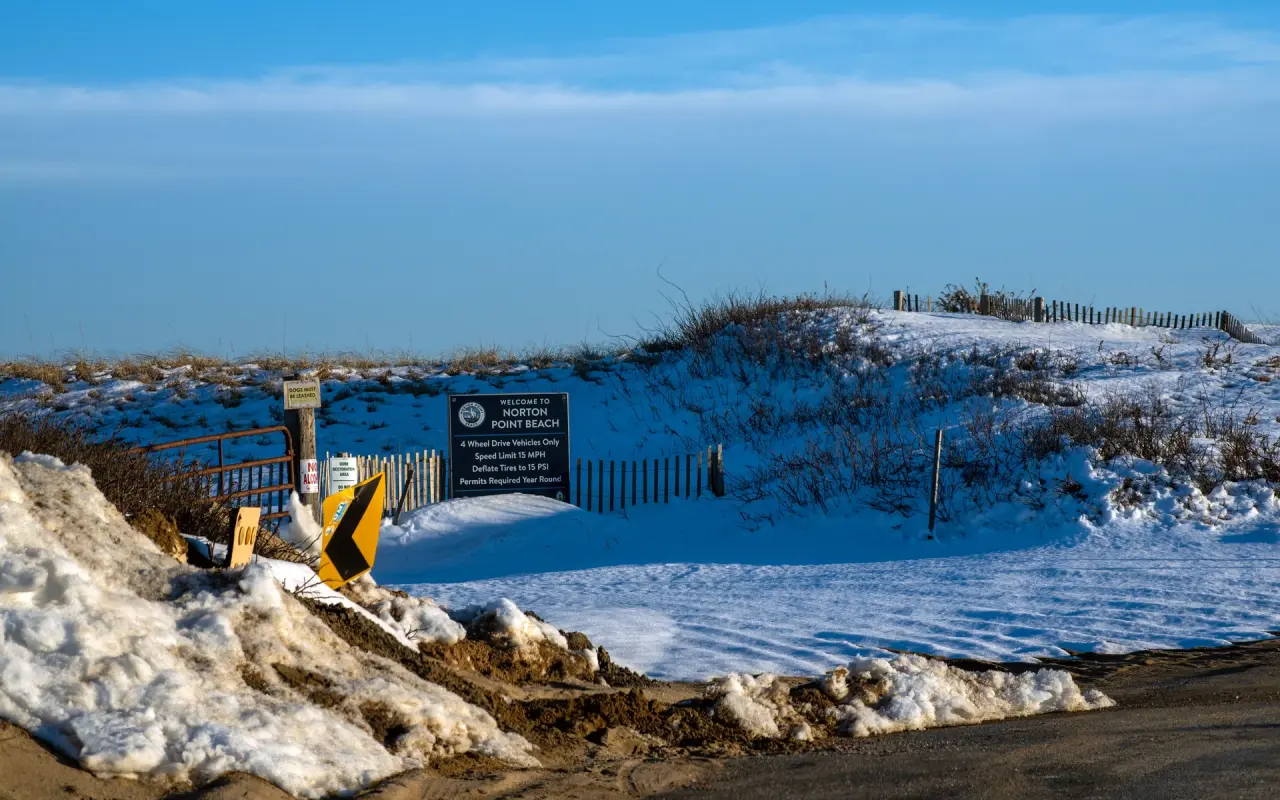
The Norton Point entrance in February 2026, snow over the dunes and the sign spelling out the rules: four-wheel-drive vehicles only, 15 mph, tires down to 15 psi, permits required year round.
Piers, jetties and bridges: the rules that are written down
Most shore fishing here happens on public beaches and town land with few written rules beyond the state’s. These are the ones we found.
Shore rules
Spot by spot
OAK BLUFFS FISHING PIER
Next to the ferry dock in Oak Bluffs, built for anglers with $1.2 million in saltwater permit money, opened in 2014, and one of the few wheelchair-accessible docks on the island. The town manages it under an agreement with the state. Jumping off it is against a town bylaw, and the town and the state have posted no-jumping signs; in summer that is the pier’s running argument. Dick’s Bait and Tackle donates a big circular net for the pier every year, and in season the Oak Bluffs library lends fishing rods (most are stored for the off-season from October).
EDGARTOWN MEMORIAL WHARF
Listed in the state’s saltwater guide as a public fishing pier, at the foot of Main Street in Edgartown. The Derby’s 2026 shore albie leader, 13.70 pounds, was caught live-lining off it. Boats and the Chappy ferry come and go beside it, so watch your line.
MENEMSHA
Chilmark’s beach rules allow no fishing in the designated areas of Menemsha Beach, the town swimming beach beside Dutcher Dock; people fish from the jetties. Dutcher Dock is a working dock. More in our Menemsha guide.
STATE BEACH BRIDGES
The county’s rules for Joseph Sylvia State Beach have no fishing ban, and anglers fish from both Beach Road bridges. The current in the inlets is fast and boats pass underneath.
LAND BANK PROPERTIES
The Land Bank lists the properties where fishing is allowed, among them Great Rock Bight, Blackwater Pond Reservation, Tashmoo Preserve and Chappy Point Beach. Ice House Pond is not on the list.
EVERYWHERE ELSE
We found no written rules for fishing the Tashmoo jetties, the Oak Bluffs harbor jetties or the Vineyard Haven docks. The posted signs and the harbormaster have the final word, and swimmers and boats need room.
Oak Bluffs · the fishing pierPhoto by MV Vacation
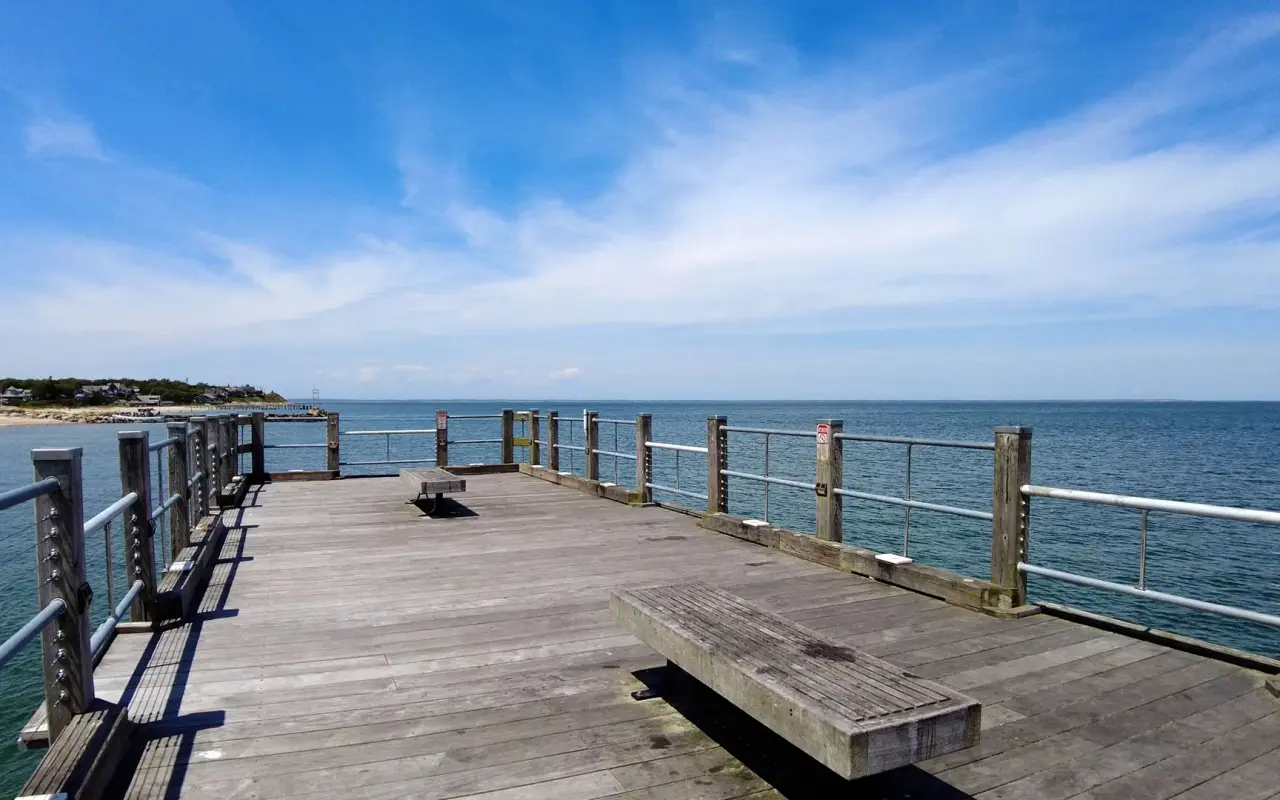
The Oak Bluffs Fishing Pier with nobody on it yet: a wide, level deck with benches and steel rails over Nantucket Sound. Saltwater permit fees built it, and it opened in 2014 beside the ferry dock.
Aquinnah: where an angler can park
Aquinnah has some of the island’s best-known shore water and some of its tightest parking. In season the signed spaces at Lobsterville Beach and West Basin are for cars with an Aquinnah resident parking permit (the county’s beach list gives Lobsterville “limited parking for town residents only”), and Philbin Beach needs a town permit for any access. The ways in for an angler:
Dogfish Bar. The Division of Marine Fisheries bought this stretch in 1996 to keep it open for shore fishing and keeps five off-road parking spaces there, for shore-fishing access only; roadside parking is not allowed. From State Road, turn right on Lobsterville Road, left on Lighthouse Road, then right on the unpaved Oxcart Road. DMF’s own Dogfish Bar page promises “unparalleled spring striped bass fishing and riveting fall false albacore fishing.”
During the 2026 Derby, thanks to the town, Derby anglers may park parallel to West Basin Road inside the marked boundaries, as far off the road as they can without harming the dunes. The marked paths matter here: the West Basin dunes have special significance to Wampanoag tribal members. A swimming area near the jetty is closed to fishing from 9 AM to 3:30 PM, and new this year, Derby anglers may use the Philbin Beach lot from 5 PM to 8 AM.
Next door in Chilmark, Squibnocket Beach needs a town permit for all access from June 15 to Labor Day.
Selling your catch, and giving it away
Nothing caught on a recreational trip may be sold in Massachusetts, whether it came from the shore, your own boat or a charter; the only exceptions are bluefin tuna and swordfish, which have their own federal rules. Recreational and commercial fishing cannot happen on the same trip, either. If you are in the Derby and have more fish than you can use, the Derby’s fillet program takes whole, well-iced fish and fillets them for island elders.
Letting them go well
Much of what anglers catch here goes back: out of season, short, over the slot or simply not wanted. DMF’s handling advice is short and worth keeping in mind:
Wet your hands before you touch the fish; a dry cloth or gloves can strip off the slime and scales it needs.
Support its whole body. Never hold a fish by the gills or the eyes, or up by the jaw alone.
Get the hook out quickly with a dehooker or pliers, and if it is deep in the mouth or gut, cut the line close to the hook.
Keep it out of the water only as long as a quick photo or measurement takes.
Put it back head first, and if it needs help, hold it and move it gently back and forth so water runs over its gills before you let go.
For stripers the rules already do part of this for you: circle hooks with bait, no gaffs, and no stringers or live wells.
Shellfish, lobster and crabs are another rulebook
Everything above is about finfish, and finfish rules are state rules. Shellfish rules are town rules: each of the six towns sells its own permit for its own water, with its own limits and seasons, and bay scallops are closed statewide from April 1 to October 1. Our oysters, scallops and quahogs guide covers the basics, and our town-by-town guide to visitor shellfish permits has each town’s permit, limits and scallop dates. Recreational lobstering takes its own state lobster permit, with 15 lobsters a day and every trap out of the water by November 1; our lobster guide has the rest. Blue crabs need no permit unless you go after them with scuba gear: 5 inches across the shell, spine to spine, 25 a day, and no traps.
For salt water, yes, if you are 16 or older: a Massachusetts recreational saltwater fishing permit, $10 (free but still required from 60), good to December 31 and needed even if you release everything. Anglers on a permitted party boat or charter are covered by the boat. The ponds need a separate freshwater license from age 15.
How much does the permit cost a visitor?
The saltwater permit is $10 for residents and non-residents alike, $13.38 if you buy it online with the fees. A non-resident freshwater license is $50 for the year or $30.50 for three days, plus a $5 Wildlands Conservation Stamp.
Do kids need a fishing license?
Not for salt water under 16, and not for fresh water under 15. The size and bag limits still apply to anything a child keeps.
Do I need a license on a party boat or a fishing charter?
No. Anglers on a permitted for-hire boat are exempt from the saltwater permit. On board, the bluefish limit is 7 instead of 5 and the fluke minimum is the boat size, 17.5 inches. The Skipper in Oak Bluffs lists licenses and bait in its $100 fare (its page was last updated in August 2025).
Can I keep a striped bass?
Yes, one a day, at least 28 inches and less than 31, all year. With natural bait you need an inline circle hook, gaffs and stringers are not allowed, and the fish stays whole until you are ashore. Striped bass are not eligible in the Derby.
What can I keep from shore in October?
Through October 14: one striper in the slot, 5 bluefish, 5 bonito and false albacore combined at 16 inches fork length, 2 black sea bass at 16 inches, 30 scup at 9.5 inches and 3 tautog at 16 inches. From October 15, black sea bass are closed and the tautog limit rises to 5. Fluke have been closed since September 23.
Can I sell the fish I catch?
No. Nothing caught on a recreational trip, from shore, a private boat or a charter, may be sold in Massachusetts. The only exceptions are bluefin tuna and swordfish, which have their own federal rules.
Do I need a permit to drive on the beach to fish?
Yes: a Trustees over-sand permit for Cape Poge and Leland Beach on Chappaquiddick, where Wasque is closed to vehicles this year, or a Town of Edgartown sticker for Norton Point. On foot you need no beach permit; Wasque charges $25 to park a car for non-members in season, and walkers and cyclists get in free.
Where can I park to fish in Aquinnah?
At Dogfish Bar, where the state keeps five off-road spaces off Oxcart Road for shore anglers. Most other signed parking near Lobsterville and West Basin is for Aquinnah residents in season. During the 2026 Derby, registered anglers could also park along West Basin Road inside the marked lines and in the Philbin Beach lot from 5 PM to 8 AM.
How we checked this
Every rule on this page was read at its source on October 2, 2026: the Division of Marine Fisheries regulations table (last updated April 28, 2026), its 2026 angler and for-hire posters and its April 23 and June 17 advisories; MassWildlife’s 2026 license fees and freshwater regulations; NOAA Fisheries’ HMS permit, bluefin and longfin squid pages; the Derby’s 2026 rules brochure and announcements; the Trustees’ permit page and FAQ; the Town of Edgartown, Dukes County and Land Bank pages; DMF’s own pages for Dogfish Bar and the Oak Bluffs pier; and, for the pier, the Derby leader and the Cape Poge injunction, the MV Times and the Vineyard Gazette. Where a price or a rule is not published, such as the 2026–27 beach permit prices or rules for the harbor jetties, we say so rather than guess. If you find something that has changed, tell us through the contact page and we will update it.
Island tip of the dayTimingNo. 58 of 79New tip at midnight, island time
Oak Bluffs restaurants are packed 6–8 PM. Eat at 5 PM or after 8:30 PM: same food, half the wait, easier parking.
Useful?
More on
Four free downloads · 2026 editions
Four island guides, in your inbox
The Beach Guide (all 20 beaches decoded), The Vineyard in the Fall, the season date by date, Where to Stay, every town and price band, and What It Really Costs, the 2026 budget line by line. All four PDFs free, plus a short island letter when there is something worth telling. No schedule, no spam.
No spam, unsubscribe in one click. Want a look first? See what you get.
First email ever from us? Give it a minute, and peek in spam once.
Disclaimer: The information in this article is provided for general guidance only and was accurate at the time of writing. Beach conditions, hours, prices, lifeguard schedules, ferry fares, and business operations change frequently and without notice. Ocean swimming carries inherent risks including rip currents, undertow, and cold water shock. Always verify current conditions with official local sources before your visit. MV Vacation assumes no responsibility for any loss, injury, or inconvenience resulting from the use of this information. Swim only where lifeguards are on duty, supervise children at all times near water, and follow all posted safety signs.
A guide to Martha's Vineyard, written on the island: beaches, dining, events and island living. We write down what we know about the island so your trip goes the way you hoped.
Where to learn to sail on Martha's Vineyard, checked October 2026: Sail Martha's Vineyard's summer classes on Lagoon Pond, private lessons for adults, Sunfish rentals in Vineyard Haven and Menemsha, schooner and catboat sails, summer races you can watch or crew, and what the wind and currents are like.
Shellfishing on Martha's Vineyard town by town: what each of the six towns charges a visitor for a permit and what it covers, where to buy it, weekly limits and sizes, the 2026 to 2027 bay scallop dates published so far, how to check storm and rain closures, and keeping the catch safe to eat.
Martha's Vineyard shore fishing spot by spot: the Oak Bluffs pier, Memorial Wharf, State Beach, Menemsha, Lobsterville, Dogfish Bar, Squibnocket, Lambert's Cove, Tashmoo, Cape Poge, Wasque, Norton Point and South Beach, with legal parking, resident-only rules, hazards and a monthly calendar.
MV fishing guide: the 81st Derby, the shore spots everyone knows by name, charter prices, monthly calendar, tackle shops, and beginner tips.
Subscribe
The free island library · 2026
One short island letter, and all four guides to start
Beach reports, events worth a day, ferry heads-ups. Sent when there is something worth telling. The Beach Guide, The Vineyard in the Fall, Where to Stay and What It Really Costs arrive with your welcome email.
The Beach Guide, The Vineyard in the Fall, Where to Stay and What It Really Costs. No spam, one-click unsubscribe.
We use cookies for trip planning, site stats and ads, including ads based on your browsing. To opt out, turn on Global Privacy Control in your browser. Cookie policy
These cookies are essential for the website to function properly.
These cookies help us understand how visitors interact with the website.
These cookies are used to deliver personalized advertisements.