Compare weather, crowds, prices, and ocean temps for every month on Martha's Vineyard. September is the month islanders keep for themselves.
Our interactive Month Picker takes your month and dates and builds this brief for you: verified climate, ferry notes for your exact dates, events and what is open.
Filmed January 2024The island moves on: shops, signs and prices may differ from what you see here. The text of this guide was checked October 2026.
A blue striped beach umbrella on the stony sand on a sunny day.
Ask ten people when to visit Martha's Vineyard and nine will say July or August. They're not wrong, but the island changes a lot month by month, and the "best" time depends on what you care about most: warm water, empty beaches, lower prices, open restaurants, or all of those at once. Couples: the honeymoon guide ranks the months for two.
From May through October the months differ in weather, ocean temperature, crowds, hotel prices, how many restaurants are open, and the bugs.
In short, September comes out ahead on nearly every count for most visitors. August is the most popular month (not July, as many assume). Swimming season is only three months long.
If you are reading this in October, November or December, now is a good time if what you are after is the island without the crowd: beaches to walk on your own, foliage that peaks late here, off-season room rates and a small calendar of local events. It is not a swimming trip, and many seasonal places have closed for the winter, so think of it as a different trip rather than a lesser one. The October to December section further down has the weather, the boats and the 2026 dates.
Every month side by side
Metric
May
June
July
August
September
October
Avg High (°F)
65°F
74°F
80°F
80°F
74°F
64°F
Avg Low (°F)
49°F
58°F
64°F
64°F
58°F
48°F
Ocean Temp (Sound side)
54–55°F
64°F
71–73°F
73–75°F
69–70°F
62°F
Days with Rain
12
10
8
9
9
11
Crowd Level (1–10)
2–3
5–6
8–9
9–10
4–5
~2
Hotel Prices
$
$$–$$$
$$$–$$$$
$$$$
$$–$$$
$
Restaurants Open
Reopening in waves, most by Memorial Day
Nearly all
All
All
Most; a first wave closes
Closing in waves
Sunset (mid-month)
about 7:55 PM
about 8:15 PM
about 8:15 PM
about 7:40 PM
about 6:50 PM
about 6:00 PM
Top Event
Memorial Day weekend reopenings
Amity Week in Edgartown (Jaws events)
Edgartown Fourth of July parade and fireworks
Agricultural Fair
International Film Festival
Striped Bass and Bluefish Derby
Greenhead Flies
None
Starting
Building to the peak
Peak early, then fading
Last few
None
Where the numbers come from: air temperatures and rain days are NOAA's 1991 to 2020 normals for Edgartown (a rain day is any day with at least 0.01 inch); water temperatures are NOAA's monthly averages for Woods Hole and the Nantucket Sound buoy, so the surf beaches on the south shore can feel different; sunsets are for Edgartown at mid-month; crowd and price levels are our own scale.
The Derby, the beaches that open to everyone and what closes when, date by date. Free with the island letter, together with our other three island guides.
One-click unsubscribe, and we never share your email.
Weather: what the numbers mean
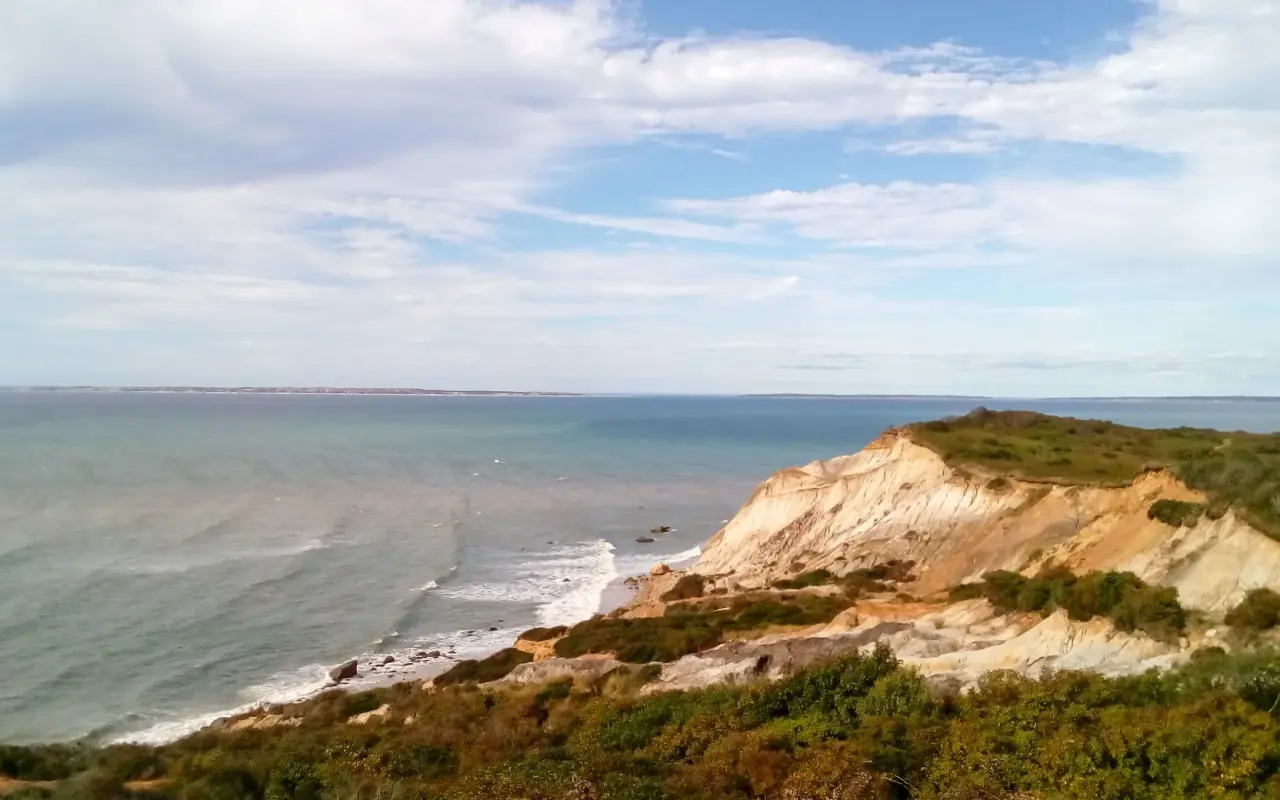
Aquinnah · the west endPhoto by MV Vacation
The cliffs at Aquinnah above the water on the island’s west end. The ocean around the island keeps it a few degrees cooler in summer and warmer in winter than the mainland.
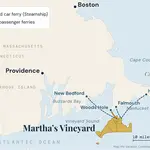
Martha's Vineyard sits a few miles off Cape Cod, and the water around it sets the climate: it warms the island in spring and fall and cools it in summer. On paper the gap is smaller than many people expect: NOAA's normal July high is about 80°F in Edgartown against 82°F at Boston's Logan Airport and 84°F in Providence, and the normal January high is about 40°F here against 37°F in Boston. The breeze off the water is what you notice most.
July and August: peak summer
July and August have the same average highs (80°F) and lows (64°F). The one difference is small: July is the driest month of the year, with about 8 days of measurable rain to August's 9. June and July are the foggiest months: pretty in its own way, not ideal if you came for the views.
Shoulder season: May, September, October
June is often overlooked. Average highs reach 74°F, the same as September, with far fewer crowds than August and most restaurants already open. May runs cooler at 65°F and can feel cold on the water, but the moody light in May is what the landscape photographers come for.
September averages 74°F highs, the same as June, but the water is much warmer (still close to its August peak after a full summer of heating). October drops to 64°F highs and 48°F lows: jacket weather, though often bright and clear.
Rain and fog
No month is reliably dry. Days with measurable rain range from about 8 in July to 12 in May. Even on rain days, showers are often brief and afternoon skies can clear. On days that look borderline, it helps to save the indoor things (museums, restaurants, galleries) for the morning.
Ocean temperature: the 3-month swimming window
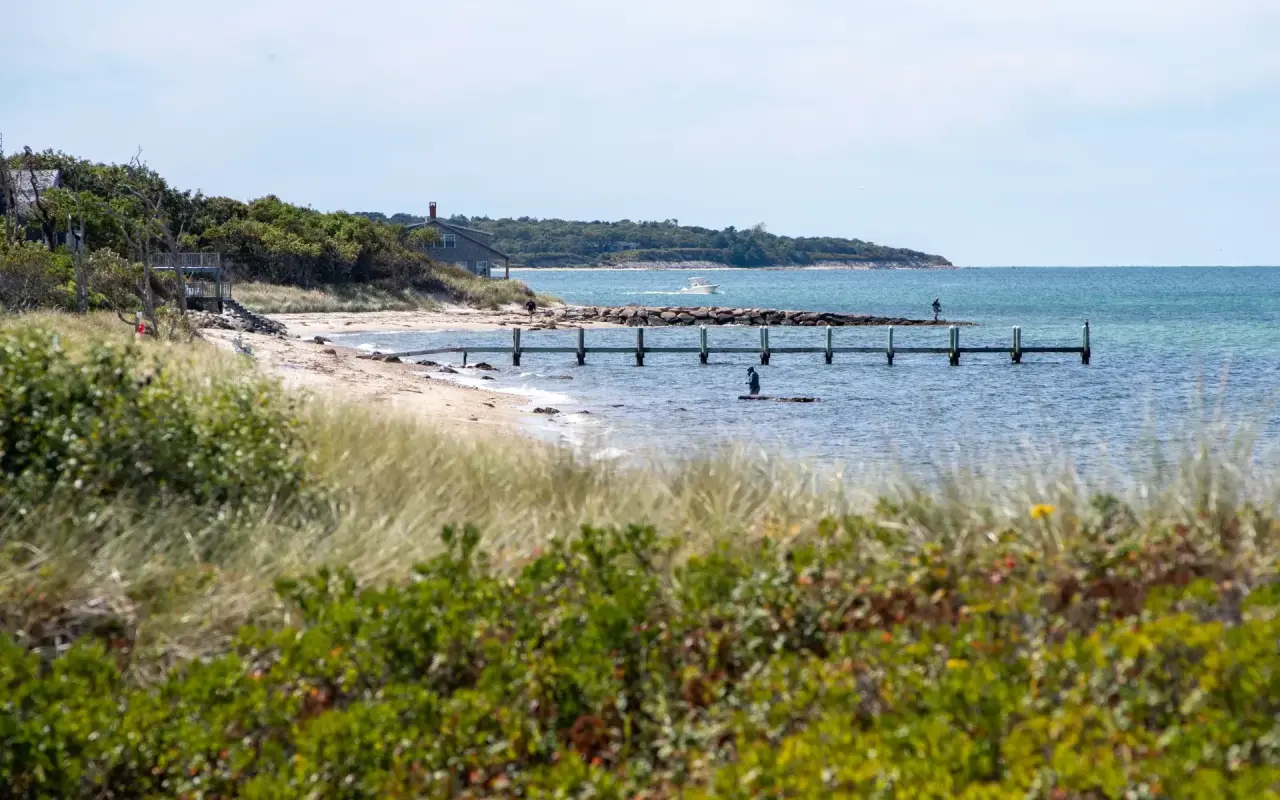
July to September · swim seasonPhoto by MV Vacation
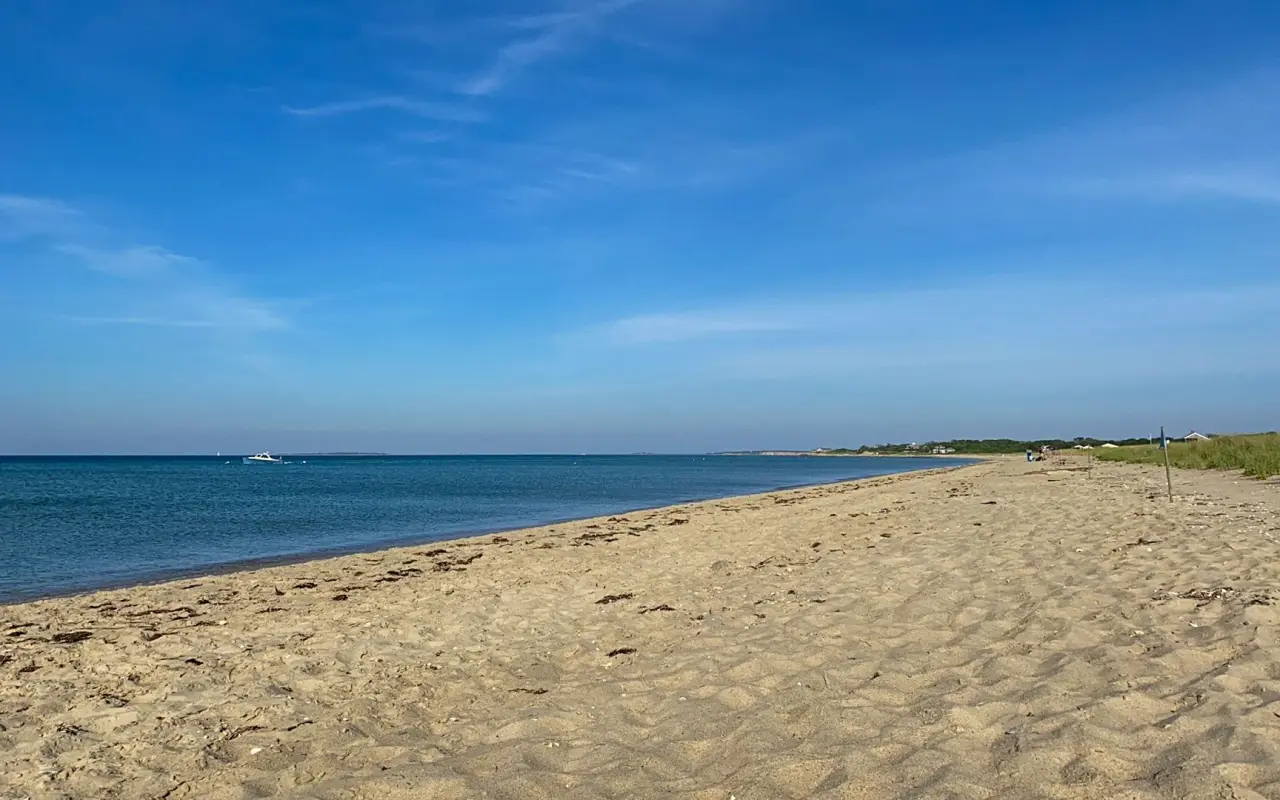
A calm beach, a long dock and someone already wading in. On the Sound side the water is warm enough for most swimmers from July into September; May and June are cold-water months.
The ocean around Martha's Vineyard warms up slowly and on its own schedule. The numbers below are NOAA's monthly averages for the Sound-side water (Woods Hole and the Nantucket Sound buoy); the surf beaches on the south shore face the open Atlantic, so treat them as a guide rather than a promise.
May (54–55°F): Only for people who like cold water, though you'll have the beaches to yourself.
June (about 64°F): Getting warmer, from the low 60s early in the month to the upper 60s by the end. Kids will wade in; many adults will hesitate.
July (71–73°F): Crosses the comfort line early in the month, and real swimming season starts.
August (73–75°F): The warmest water of the year.
September (69–70°F): Still very good: the first half of the month averages about 72°F, as warm as early July.
October (about 62°F): Cold again, from the mid 60s early in the month to about 60°F by the end. Wetsuit territory for most people.
That makes swimming season only three months long: July, August and September. Early September is the best deal of the three: the water is still warm from the summer (about 72°F in the first half of the month), crowds are much smaller, the greenhead flies are past their peak (on Cape Cod they are most abundant from July through mid-August), and hotel rates usually come down after Labor Day. Our beach guide has the best spots by month.
Crowds and costs
Peak summer · the busy monthsPhoto by MV Vacation
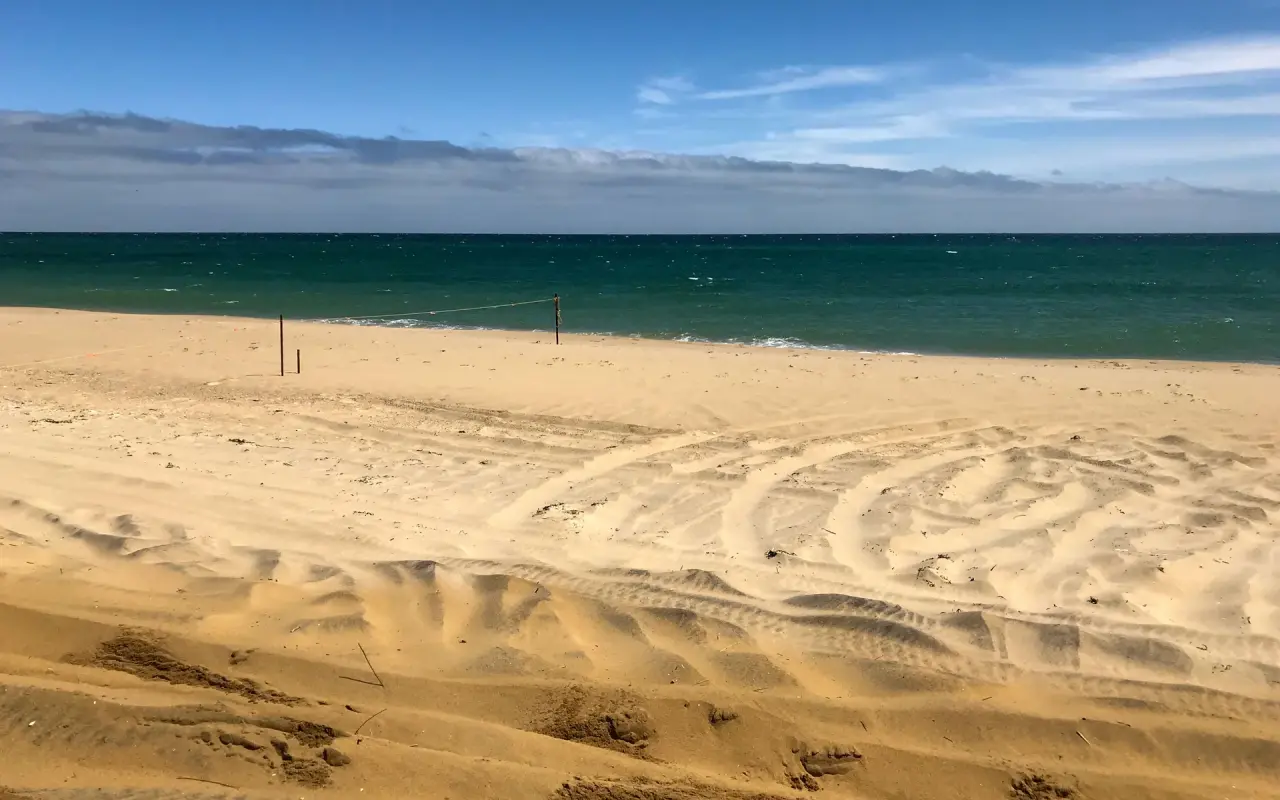
An ocean beach with nobody on it yet, tire tracks across the sand and a volleyball net strung near the water. In July and August a beach looks like this only early; later in the day the sand fills up.
The 2020 Census counted about 20,530 year-round residents on Martha's Vineyard. On peak August days, the Martha's Vineyard Commission's 2024 estimate puts the island's population at about 94,650, 4.6 times the year-round number, and you feel it on the ferries, the roads, in the restaurants and at every beach lot.
August, not July
Many visitors assume July is the busiest month. The Martha's Vineyard Commission puts the island's population peak in August, and the middle of the month, when the Agricultural Fair and Grand Illumination Night fall, is the densest stretch of the island calendar. Driving on means long ferry waits, and foot passengers will want to plan around peak sailing times. Our complete ferry guide covers booking.
What prices look like
The gap between shoulder season and peak is large. A rate check of our own shows the pattern. The Mansion House in Vineyard Haven showed about $231 to $664 a night for February dates against $494 to $988 for July when we checked its booking engine on September 18, 2026. After Labor Day, hotel rates usually come down from the August peak. Rates move with the date and the room, so read these as a pattern, not a quote; our trip cost calculator prices a whole trip by month.
Most places to stay follow the same pattern. Our where to stay guide has options for every budget, and the budget travel guide has ways to spend less in any month.
What's open, month by month
Off-season · a quieter islandPhoto by MV Vacation
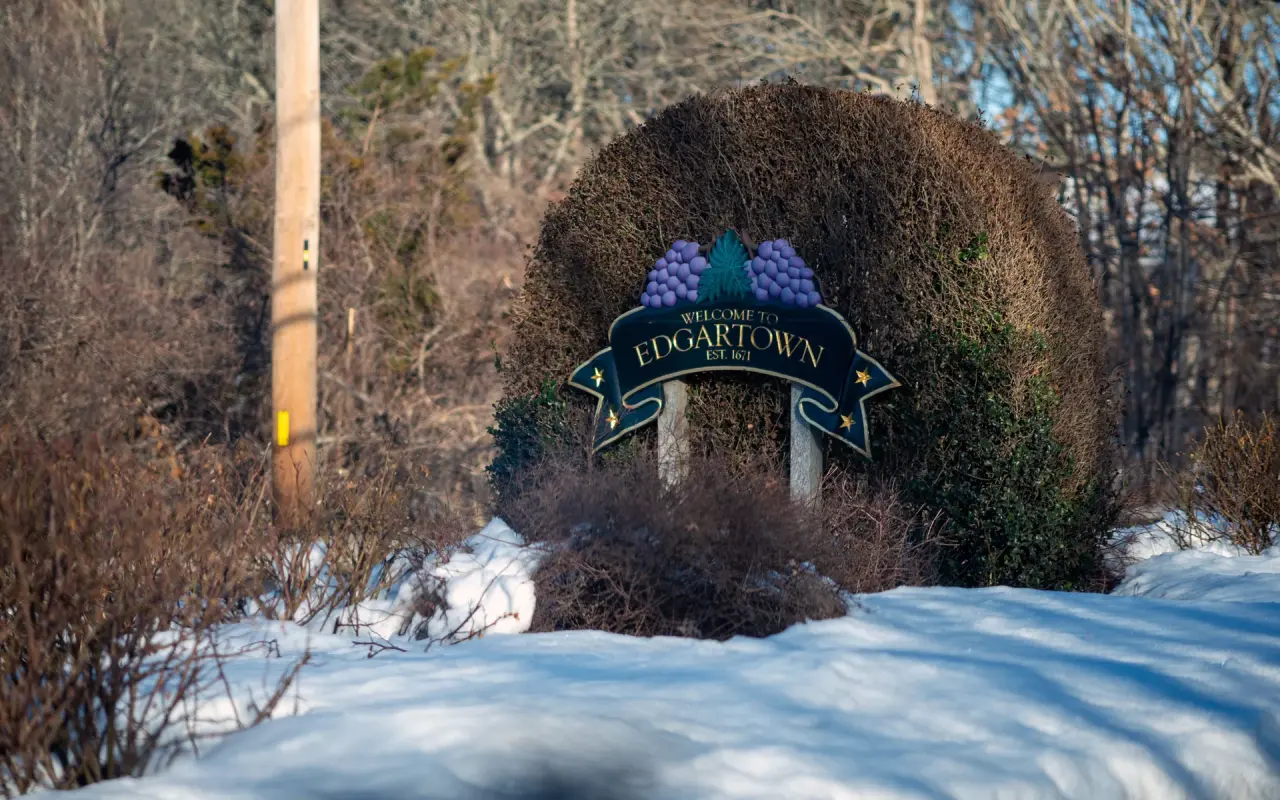
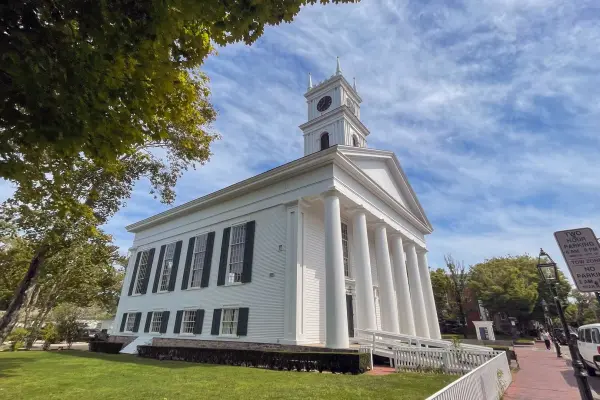
The Welcome to Edgartown sign in winter 2026, with snow on the ground and the trees bare behind it.
Martha's Vineyard is a seasonal economy. Many businesses close entirely from November through April and reopen on a rolling schedule.
May: reopening in waves
Early May still runs on the year-round core, places like the Black Dog Tavern that cook all winter, and the seasonal spots reopen in waves through the month; by Memorial Day weekend nearly all of them are running. Grocery stores, gas stations and essential services are open all year. Our May guide has the details.
June: nearly everything open
Nearly everything is open by June, and the summer rentals start up. The West Tisbury Farmers Market opens its summer season on the first Saturday of June (Saturdays June to October, Wednesdays June to August, 9 to noon at the Ag Society grounds), and the events calendar fills quickly, while restaurant waits are still manageable.
July and August: everything open
Everything is operating, including the spots that only open for the height of summer. Waits at popular restaurants can run long without a reservation, so anything upscale is worth booking ahead.
September: most still open
The first wave of closures happens after Labor Day weekend. Beach concessions and pure summer operations shut down. But most proper restaurants stay open through September, and the reduced competition for tables means easier reservations. People who eat out a lot call September the best dining month. Read our full September guide.
October: closing in waves
Closures speed up after Columbus Day weekend, so it's worth checking a restaurant before you count on it. What stays open is what islanders use, the places that can survive a winter. Read our full October and fall foliage guide.
Edgartown · 19 RawPhoto by MV Vacation
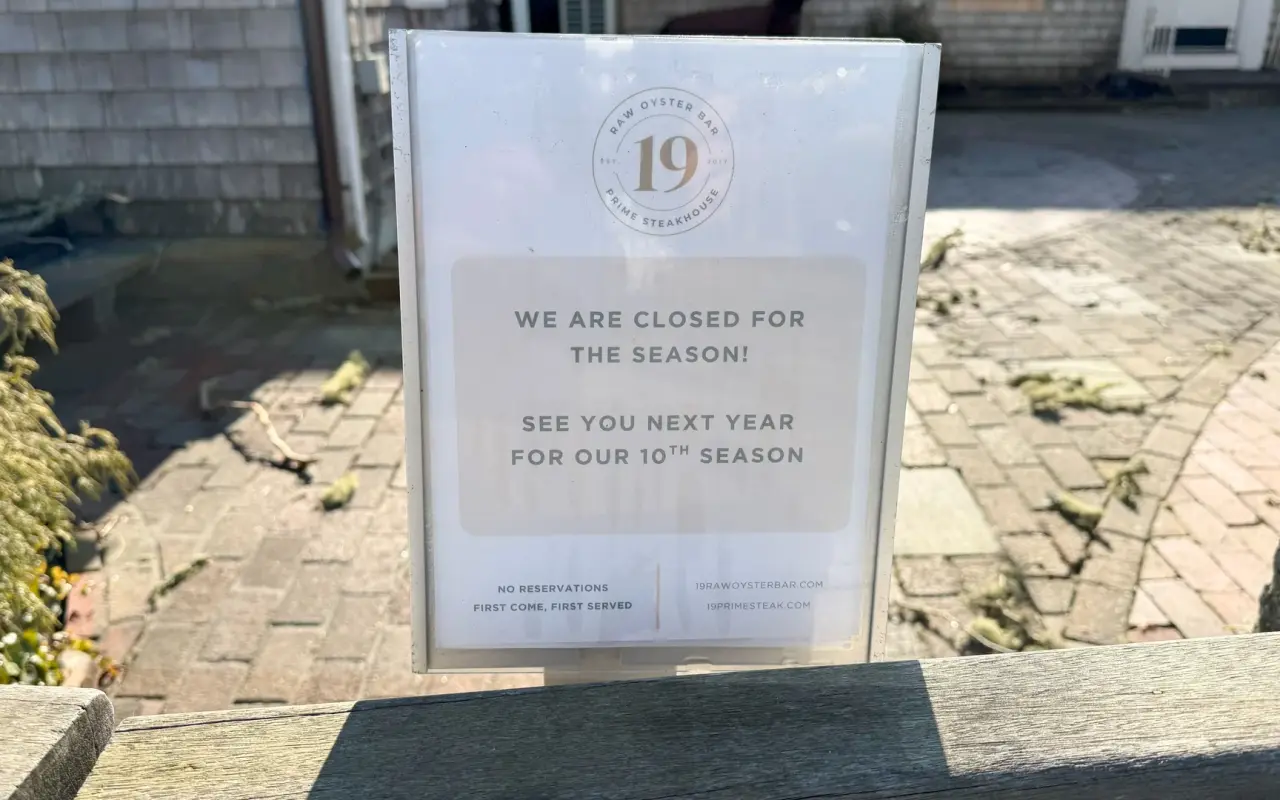
The closed-for-the-season sign at 19 Raw Oyster Bar in Edgartown. Signs like this go up at the seasonal kitchens through the fall; the places that stay open are the ones locals eat in.
Is now a good time? October to December
Off-season · an empty beachPhoto by MV Vacation
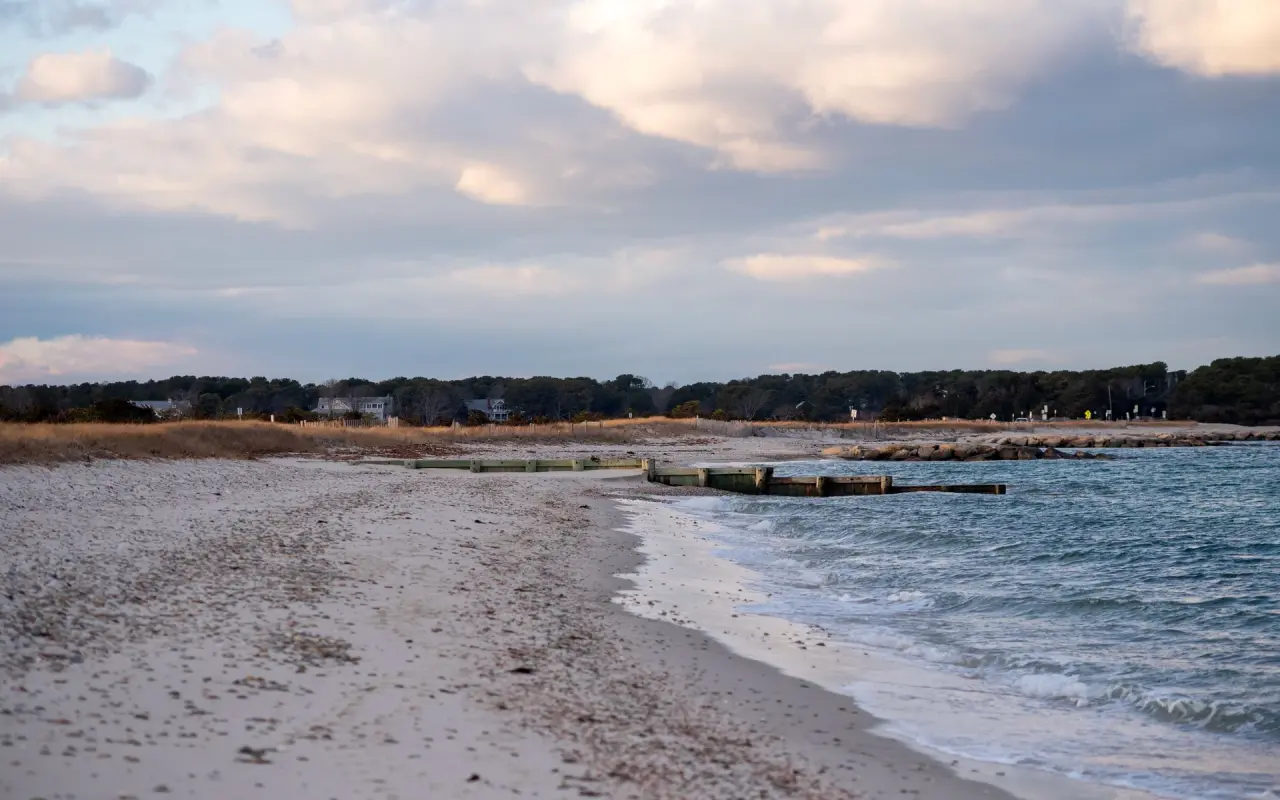
An empty beach in the off-season, low light on the water, the old groins along the sand and nobody else out.
The last three months of the year are a good time to come for walking, foliage, quiet towns and lower room rates, and a poor fit if the trip depends on swimming, a long list of restaurants or the summer boats. It's a different island: fewer places open, more room everywhere, and a calendar built around the people who live here.
Metric
October
November
December
Avg High / Low
64°F / 48°F
54°F / 40°F
46°F / 31°F
Ocean Temp (Sound side)
about 62°F
about 52°F
about 43°F
Days with Rain
11
11
12
Sunset (mid-month)
about 6:00 PM
about 4:20 PM
about 4:15 PM
Boats
Steamship to Vineyard Haven, and to Oak Bluffs until Oct 22; Island Queen from Falmouth and Seastreak from New Bedford until Oct 12; Hy-Line from Hyannis until Oct 25
Steamship, Woods Hole to Vineyard Haven; Seastreak from New Bedford to Vineyard Haven Nov 25–29 for Thanksgiving
Steamship only, Woods Hole to Vineyard Haven
What's Open
Seasonal places closing in waves
The year-round core
The year-round core, busier on holiday weekends
On the 2026 Calendar
Derby to Oct 17; Vineyard Artisans Fall Festival Oct 10–11; Harvest Festival at the Ag Hall Oct 24
Featherstone Holiday Gift Show from Nov 7; Vineyard Artisans Thanksgiving Festival Nov 27–28
Light Up Oak Bluffs Dec 5; Christmas in Edgartown Dec 10–13
October
The summer winds down in steps. The Derby fills the Edgartown weigh-in station through October 17, the Saturday farmers market in West Tisbury runs through the month, and the water is still in the mid 60s early on before it drops toward 60°F. Foliage starts around the middle of the month and, because the ocean keeps the island warm, the best color usually lands from late October into November. The boat is the thing to plan first: the seasonal ferries stop between October 12 and October 25, and from October 23 every Steamship Authority trip runs Woods Hole to Vineyard Haven. Our October guide covers the foliage drives and what stays open.
November
The quietest month of the fall. The clocks go back on Sunday, November 1, and sunset jumps from about 5:40 to about 4:40 PM overnight, so days are built around a late-afternoon walk and an early dinner. In return the beaches are free and open to walkers, the foliage often peaks in the first half of the month, and Thanksgiving week brings the island back to life for a few days. Our November guide lists what stays open.
December
Edgartown · the holidaysPhoto by MV Vacation
Shop windows and lampposts in Edgartown wrapped in holiday lights during the 2025 season. Christmas in Edgartown returns December 10 to 13, 2026.
December is the wettest month of the year, with about 12 days of rain and the first real chance of snow, and it has the island's two big holiday weekends: Light Up Oak Bluffs on December 5 and Christmas in Edgartown from December 10 to 13, 2026. It is worth booking the car on the ferry early for those weekends, since vehicles need a reservation all year. Our Christmas in Edgartown guide has the schedule.
Planning one of these months? The Trip Planner builds a day-by-day plan, the events calendar has the exact dates, our bus guide covers getting around without a car (the VTA runs every day except Thanksgiving and Christmas Day), and the free guides page has our seasonal winter guide.
Who should come when
1. Families with young children
Late June to early July. School is out, the Sound-side water climbs from the upper 60s in late June to about 71°F in early July, greenhead flies are only getting started (they are most abundant from July through mid-August), and the island is lively but not yet at its August peak. Full July guide here.
Oak Bluffs · a calm beachPhoto by MV Vacation
A long stretch of sand and flat water on a clear summer day. At State Beach in July and August it is worth getting there early, before the parking fills.
2. Couples
September. Emptier beaches, low light, easier tables, fewer children at the beach paths, and prices that have come down. September is the month for two.
3. Budget travelers
Early May or late September–October. Prices at shoulder-season lows, ferry reservations easy to come by, and the island is quiet. May is the cheapest. Our budget guide covers strategies for each month.
4. Serious beach lovers
August (or early September). August gives you the warmest water and the best odds of sun at the same time, but early September has nearly the same swimming with a fraction of the crowd on the sand.
5. Event seekers
Mid-August or early September. The Martha's Vineyard Agricultural Fair (mid-August) is the island's big event: four days of livestock, food, and entertainment. The Martha's Vineyard International Film Festival fills the Film Center in early September; the island's free Book Festival is held in Chilmark on the first weekend of August in odd-numbered years, so the next one is due in 2027. The Striped Bass and Bluefish Derby (September 13 to October 17 in 2026) draws serious anglers.
6. Eating out
September or October. Most of September's kitchens are still open and less rushed after Labor Day, with much shorter waits than August. October has fewer choices, and the year-round local spots are easier to get into.
7. Hiking, cycling and kayaking
September–October. The island's more than 220 miles of public trails (the TrailsMV count), plus the bike paths and kayak routes, are at their least congested. October adds fall foliage to trails through the Manuel F. Correllus State Forest. October guide covers the foliage timing in detail.
8. Dog owners
October. Most town beaches restrict or ban dogs from about May 15 to September 15 (Oak Bluffs, for example, during daytime hours). After mid-September most of them open to leashed dogs, though South Beach and Menemsha Beach stay off-limits all year. Our dog guide has the beach-by-beach rules.
9. First-time visitors
Late June or early September. Late June gives you the full summer experience (lively towns, everything open, warm enough to swim) without August's crowds and prices. Early September is what islanders would pick: June's weather with warm water and the quiet after Labor Day.
10. Photographers and artists
Late September or October. October has the year's best light: low, warm, almost no haze. Foliage arrives in the second half of the month. The gingerbread cottages of Oak Bluffs and the Aquinnah Cliffs look their best in autumn light.
So when is the best time?
For most visitors it's September:
The same 74°F highs as June, with a whole summer of ocean warming behind them
The water still averages about 70°F, and about 72°F in the first half of the month, as warm as early July
Crowd levels drop from 9–10 (August) to 4–5, a difference you feel the moment you step off the boat
Hotel rates usually come down from the August peak
Greenhead flies are past their July to mid-August peak
Sunset is still around 6:50 PM in mid-September
Restaurant waits shrink; same-day reservations are often possible
The Martha's Vineyard International Film Festival and the Striped Bass Derby give the month its own events
Four things people get wrong:
August is the busiest month, not July: the Martha's Vineyard Commission puts the population peak in August.
Swimming season is only 3 months (July, August, September).
June is foggier than most people expect.
October gets overlooked: it has the last weeks of the Derby and the start of the fall color, though it's worth checking what is open first.
What is the best month to visit Martha’s Vineyard?
September, for most visitors. Highs average 74°F, the Sound-side water still averages about 70°F after a summer of heating (NOAA), the greenhead flies are past their July to mid-August peak, most restaurants stay open, and hotel rates usually come down from the August peak. Families with young children may prefer late June into July, when the water climbs past the upper 60s and summer is in full swing.
When is the ocean warm enough to swim?
July, August and September. NOAA's monthly averages for the Sound-side water run 71–73°F in July, 73–75°F in August and 69–70°F in September. May and June are cold-water months (June averages about 64°F), and by October, at about 62°F, it is wetsuit territory for most people.
Which month is the most crowded?
August, not July. The Martha's Vineyard Commission puts the island's population peak in August, at about 94,650 people, and the middle of the month, when the Agricultural Fair and Grand Illumination Night fall, is the densest stretch of the calendar. If you are driving on, book the car well ahead; walk-on passengers buy tickets on the day and do not need a reservation.
What is the cheapest month?
Of the main visiting months, May, with late September and October close behind; November through April is cheaper still. Our April 2026 check of one Edgartown resort found mid-May rates at roughly a quarter of August's, and ferry car reservations are easier to get. The trade-off in early May is that many seasonal places are still reopening.
How much of the island is open in the off-season?
Seasonal places close in waves through October, and by November many seasonal businesses are closed for the winter, leaving a year-round core of restaurants, cafes, markets and museums. Grocery stores, gas, the ferry and the buses run all year. Our year-round guide lists what stays open.
Is October a good time to visit Martha’s Vineyard?
Yes, if you want foliage, walking and quiet towns more than swimming. Highs average about 64°F, the Derby runs to October 17 in 2026, and the color usually peaks from late October into November. Seasonal places close in waves through the month, the Oak Bluffs ferry stops after October 22, and the other seasonal boats end between October 12 and 25, so it pays to check hours and plan the boat first.
Is it worth visiting in November or December?
For a quiet trip, yes. November has the empty beaches, late foliage and Thanksgiving week; December has Light Up Oak Bluffs on December 5 and Christmas in Edgartown from December 10 to 13, 2026. Our November and December guides have every date. Expect highs in the 40s and 50s, sunsets before 4:30 PM, one Steamship route to Vineyard Haven (plus Seastreak from New Bedford over Thanksgiving, November 25 to 29) and a smaller year-round core of places to eat. It is a different island, not a lesser one.
The Beach Guide (all 20 beaches decoded), The Vineyard in the Fall, the season date by date, Where to Stay, every town and price band, and What It Really Costs, the 2026 budget line by line. All four PDFs free, plus a short island letter when there is something worth telling. No schedule, no spam.
No spam, unsubscribe in one click. Want a look first? See what you get.
First email ever from us? Give it a minute, and peek in spam once.
Disclaimer: The information in this article is provided for general guidance only and was accurate at the time of writing. Beach conditions, hours, prices, lifeguard schedules, ferry fares, and business operations change frequently and without notice. Ocean swimming carries inherent risks including rip currents, undertow, and cold water shock. Always verify current conditions with official local sources before your visit. MV Vacation assumes no responsibility for any loss, injury, or inconvenience resulting from the use of this information. Swim only where lifeguards are on duty, supervise children at all times near water, and follow all posted safety signs.
A guide to Martha's Vineyard, written on the island: beaches, dining, events and island living. We write down what we know about the island so your trip goes the way you hoped.
Martha's Vineyard in December 2026: First Friday on December 4, Light Up Oak Bluffs on December 5, Christmas in Edgartown December 10 to 13, 4:15 sunsets, one ferry into Vineyard Haven, and what stays open through Christmas.
Halloween on Martha's Vineyard 2026, town by town: Edgartown's Happy Haunting on Sunday, October 25, Halloween in Oak Bluffs on Saturday, October 31, the museum's Halloween on the Hill, the library events, haunted Edgartown walks and Circuit Arts' revue at the Grange, plus how the Vineyard Haven puppet parade ran in past years (set for October 31 at 4 PM).
The Hamptons or Martha's Vineyard? A New York scene two to three hours away by Jitney or train, with ocean beaches behind a $750 season permit, against a six-town island reached by an hour's flight or a day's train and boat, where thirteen beaches are free to all, the bus is free and the nights are quiet. Getting there, beaches, beds, towns, nightlife, children and cost, honestly.
Newport or Martha's Vineyard? A drivable Gilded Age city with the Breakers ($32), the free 3.5-mile Cliff Walk, festival weekends at Fort Adams and a late harbor front, against a six-town island reached by an $11 ferry with twenty beaches, a free bus and quiet nights. Getting there, sights, beds, nights, children, weddings, and doing both from Rhode Island.
Block Island vs Martha's Vineyard, honestly: a 9-square-mile island with one village and a $12 year-round ferry from Point Judith against 90 square miles, six towns and an $11 boat from Woods Hole. Size, ferries (the car fare gap is huge), beds, beaches, the week versus the weekend, and which one fits your trip from Rhode Island.
New Year's Eve on Martha's Vineyard: the $150 dinner over the lit harbor, the two-seating table in Edgartown, live music at the Ritz, the family First Night at the Playhouse, where the lights are, what runs on the holiday (the ferry does, the reservation office does not), what is open on New Year's Day, and the empty January that begins the week you leave. 2026–2027 dates.
Island tip of the dayTimingNo. 61 of 79New tip at midnight, island time
Visit Edgartown on a Tuesday or Wednesday. Same beautiful town, maybe 30% of the weekend crowds. Most restaurants have availability without reservations.
Useful?
More on
Subscribe
The free island library · 2026
One short island letter, and all four guides to start
Beach reports, events worth a day, ferry heads-ups. Sent when there is something worth telling. The Beach Guide, The Vineyard in the Fall, Where to Stay and What It Really Costs arrive with your welcome email.
The Beach Guide, The Vineyard in the Fall, Where to Stay and What It Really Costs. No spam, one-click unsubscribe.
We use cookies for trip planning, site stats and ads, including ads based on your browsing. To opt out, turn on Global Privacy Control in your browser. Cookie policy
These cookies are essential for the website to function properly.
These cookies help us understand how visitors interact with the website.
These cookies are used to deliver personalized advertisements.