By MV VacationUpdated 13 Oct, 202630 mins read 3,579 views
Updated for 2026: Martha's Vineyard tick safety. Four species now including the Asian longhorned tick, 2025 alpha-gal figures, the island's new tick clinics, prevention, removal, and the latest Lyme vaccine news.
Martha's Vineyard has the highest rate of tick-borne disease in Massachusetts, and by every measure the problem got worse in 2025 and 2026. Martha's Vineyard Hospital ran 1,689 alpha-gal tests in 2025 and 742 came back positive, nearly as many as the previous five years combined. The state made alpha-gal syndrome a reportable condition on April 1, 2026, two tick clinics and a hospital alpha-gal research center opened on-island in 2026, and a drone survey counted 4,681 deer roaming the Vineyard. If you spend time outdoors here, ticks are the health risk to plan for.
We first published this guide in September 2025, updated it in full in July 2026 and re-checked it in October 2026, using the latest data from Martha's Vineyard Hospital, the Massachusetts Department of Public Health, Tufts University, and the island's tick program. Each number below names its source, so you can check it yourself.
The island has everything a tick needs. Deer are abundant and have no natural predators, the woods and old stone-wall edges run right up to people's yards, and the mild coastal climate stretches the season at both ends. Add hundreds of thousands of summer visitors walking those same trails and beaches, and the encounter rate climbs.
Island-wide · The HostsPhoto by MV Vacation
Two bucks at the edge of the brush: the island’s dense deer population is a big part of why tick numbers stay high.
The result shows up in the health data. Using 2020–2024 figures from the Massachusetts Epidemiologic Virtual Network, contract epidemiologist Lea Hamner found that Lyme disease on the Vineyard runs about 11 times the statewide rate. Martha's Vineyard Hospital's 2025 Community Health Needs Assessment puts local emergency-room visits for tick bites at 500 percent higher than any other Massachusetts county. (You may still see an older figure of 135.34 tick-related ER visits per 10,000 people quoted for Dukes and Nantucket counties: that was a cumulative multi-year rate; the current framing is roughly 10 to 11 times the state average.) In April 2026 the CDC's national Tick Bite Tracker showed emergency-room visits for tick bites at their highest for that time of year since its data begin in 2017.
The four tick species on Martha's Vineyard
For years the island had three ticks to worry about. Now a fourth has arrived.
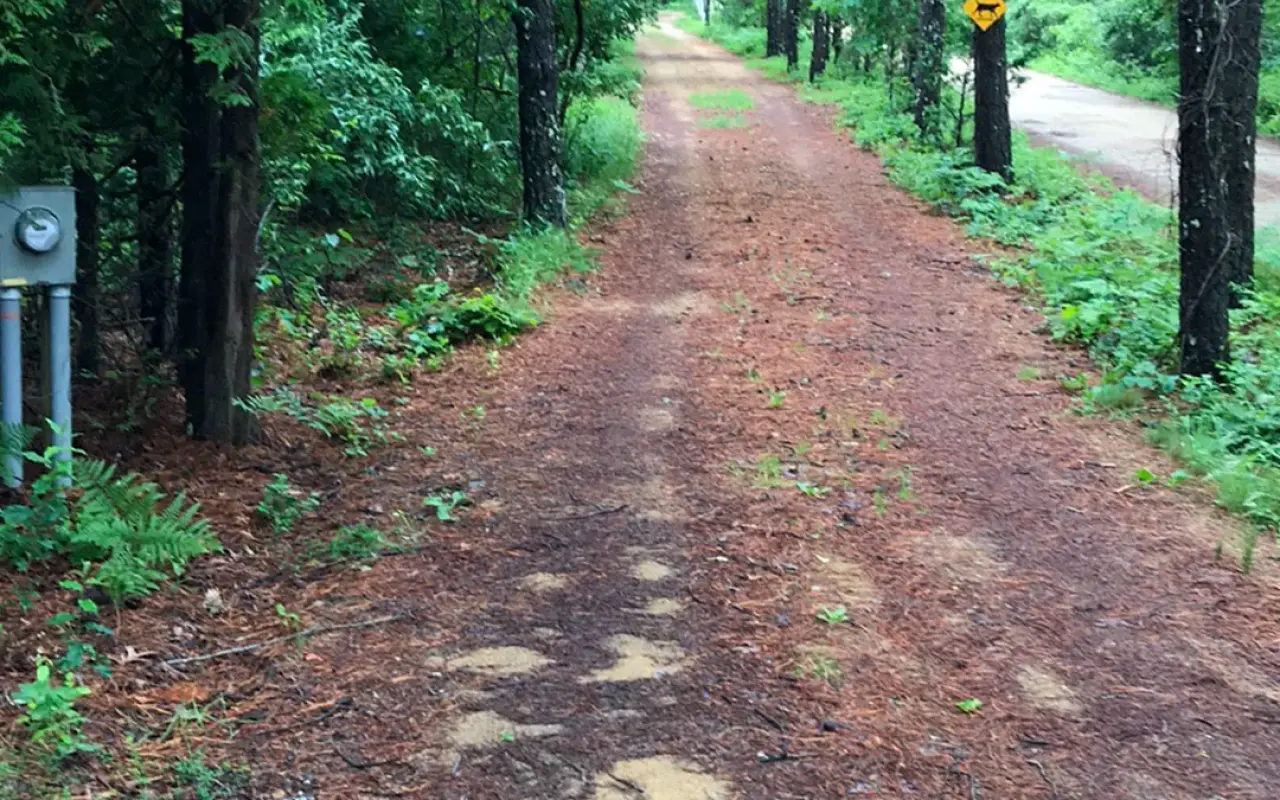
Martha’s Vineyard · the woodsPhoto by MV Vacation
A pine-needle path through island woods. Deer ticks wait in the leaf litter and the low brush along edges like these.
1. Deer ticks (black-legged ticks)
Scientific name:Ixodes scapularis Size: Poppy seed as a nymph, sesame seed as an adult Diseases transmitted: Lyme disease, babesiosis, anaplasmosis, Powassan virus, Borrelia miyamotoi Peak activity: Adults from October into May, and on any winter day above about 40°F; nymphs peak May through July
The deer tick is the island's biggest disease carrier. You may have heard that a tick "must be attached for 24 to 48 hours to transmit Lyme," but the science does not support a fixed window like that. The CDC says an infected tick generally needs to be attached more than 24 hours to pass Lyme, and prompt removal lowers the risk, but a 2015 review in the International Journal of General Medicine concluded the true minimum has never been established, and in animal models transmission has happened in under 16 hours. The window also does not apply to the other pathogens here: Powassan virus can pass in as little as 15 minutes, and anaplasmosis and B. miyamotoi can transmit inside the first day. So there is no "safe" window, and the best thing to do with an attached tick is take it off the moment you find it.
2. Lone star ticks
Scientific name:Amblyomma americanum Identification: Females carry a single white dot on the back Diseases transmitted: Alpha-gal syndrome (a red-meat allergy), ehrlichiosis, tularemia Peak activity: Mid-March through October
The lone star tick was first documented on the Vineyard in 1985 but only took firm hold in the last decade. A peer-reviewed study in the journal Insects (Johnson, Roden-Reynolds, Snow and Rich, September 2024) analyzed 1,265 yard surveys from 2011 to 2024 and traced its spread from two toeholds, Chappaquiddick and Aquinnah, to all six island towns. Tick biologist Patrick Roden-Reynolds says a drag survey that used to turn up a handful of lone stars now finds "anywhere from two ticks to 200 ticks in people's yards."
Late summer brings the lone star's "tick bomb." From late July into the fall, larvae hatch in clusters that can run to hundreds at once. The larvae don't carry disease, but a single misstep into a cluster can leave you with dozens of tiny bites, and repeated lone star bites are what drive alpha-gal sensitization.
3. American dog ticks
Scientific name:Dermacentor variabilis Size: Noticeably larger than a deer tick Diseases transmitted: Rocky Mountain spotted fever, tularemia Peak activity: Spring through summer (adults, roughly April to August)
Less common than the other two but still present island-wide.
4. Asian longhorned tick (new)
Scientific name:Haemaphysalis longicornis Status: First found on Martha's Vineyard in 2023; numbers rising each year
Surveyors found just three females in a pair of up-island yards in 2023, about two dozen in 2024, roughly 50 in 2025, and about a dozen in early 2026: enough, Roden-Reynolds told the Vineyard Gazette in May 2026, to raise "concerns about a population getting established here." It is worth watching because of how it breeds: a single female can lay 1,000 to 2,000 eggs without ever mating, and the larvae swarm in clusters much like the lone star's. For now it is mainly a livestock and pet concern: in the United States it has not been found carrying human pathogens in the wild, though lab studies show it can carry the agent of Rocky Mountain spotted fever. It is one to keep an eye on rather than lose sleep over.
For a fall trip
The Vineyard in the Fall, free
The Derby, the beaches that open to everyone and what closes when, date by date. Free with the island letter, together with our other three island guides.
One-click unsubscribe, and we never share your email.
What spreads Lyme here: the shrew finding
For decades the white-footed mouse got the blame for Lyme on the Vineyard, which is why so much control effort aimed at mice. Research from Tufts has complicated that story. In a study published in the American Journal of Tropical Medicine and Hygiene in November 2024, Heidi Goethert and colleagues analyzed 218 nymphal deer ticks collected in West Tisbury's Christiantown Woods between 2019 and 2023 and used blood-meal identification to work out what each tick had last fed on. About 40 percent of the infected ticks had fed on shrews, the single largest contributor over the five years.
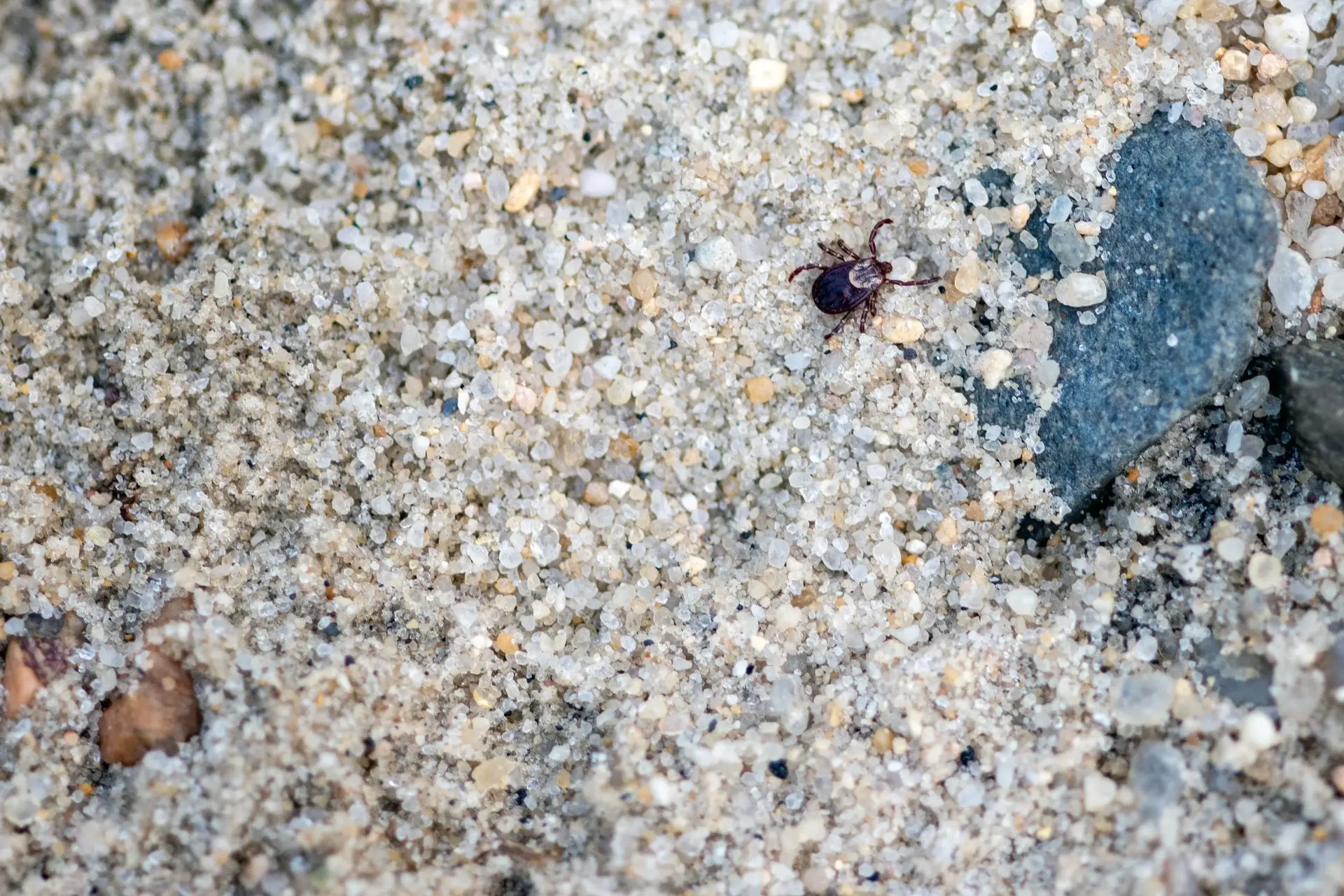
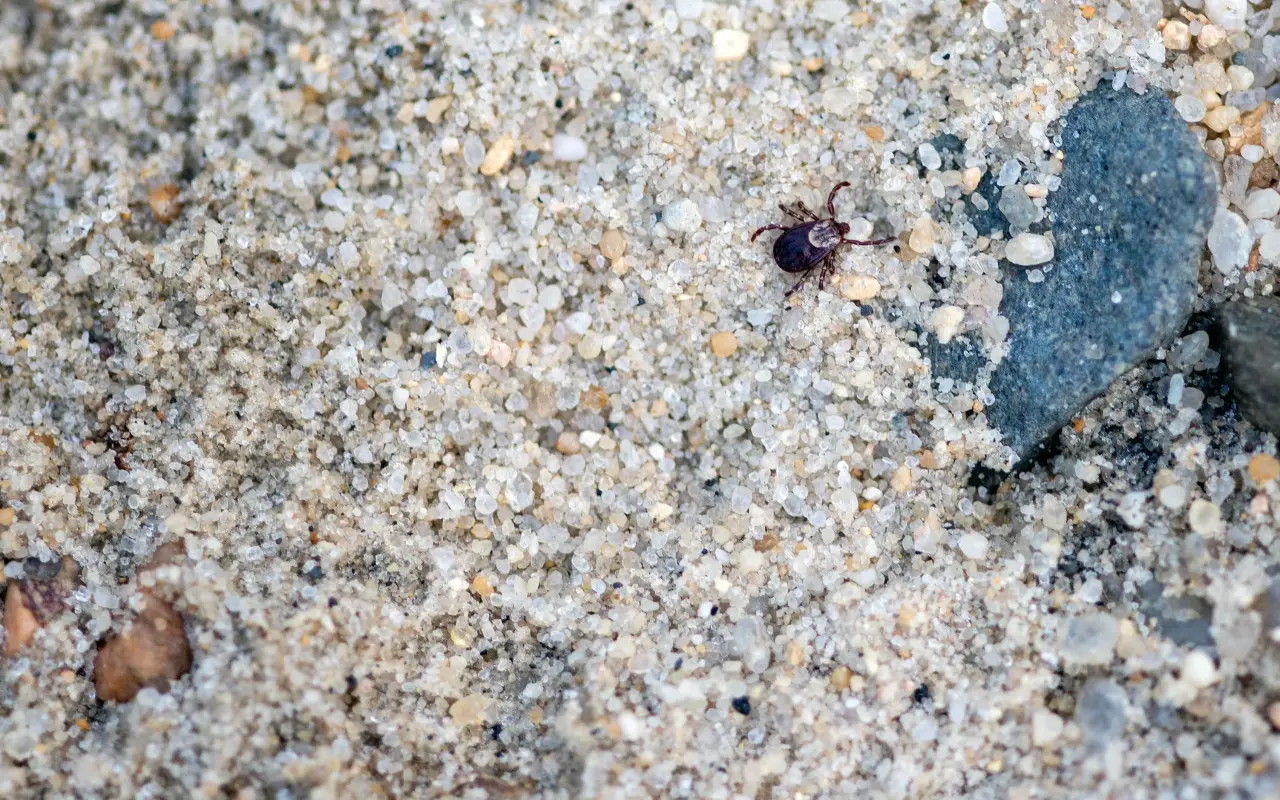
On the island · a tick on the sandPhoto by MV Vacation
A tick on beach sand: they are not only a woods problem.
Goethert frames it carefully: "The bottom line is that shrews appear to be as important as mice in transmitting Lyme, not that mice are unimportant." On the Vineyard shrews look to be as important as, or more important than, mice; on Nantucket the two contribute about equally. It helps explain why mouse-targeted measures alone have underdelivered here, and it is a reason to temper expectations for products like tick tubes that only treat mouse nests.
Alpha-gal syndrome, the fastest-growing problem
Alpha-gal syndrome is an allergy to red meat and other mammalian products triggered by lone star tick bites. The reaction is delayed, usually two to six hours after eating, which makes it easy to miss at first: hives, stomach pain and diarrhea, trouble breathing, and in severe cases anaphylaxis. There is no cure. Management means avoiding mammalian products under the care of an allergist, who may prescribe an epinephrine auto-injector or nasal spray; anyone who has to use it should still get emergency care.
The testing numbers at Martha's Vineyard Hospital show how fast it has grown:
Year
Positive alpha-gal tests
2020
2 (of 9 tests)
2021
32
2022
77
2023
140
2024
523 (of 1,254 tests)
2025
742 (of 1,689 tests)
Two caveats apply to those figures. The hospital's counts are not deduplicated, so one person tested more than once shows up more than once. And a positive IgE test means the body has become sensitized, not that the person has full-blown alpha-gal syndrome; only a portion of positives go on to develop allergic symptoms, as epidemiologist Lea Hamner has stressed. Nationally the CDC estimates up to 450,000 Americans may be affected, and a July 2026 CDC study likewise found that only a small minority of IgE-positive people have the syndrome.
Emerging evidence suggests alpha-gal sensitivity may fade over time if you avoid further lone star bites, though this should be read as "may improve with strict bite avoidance," not a guaranteed recovery. As of April 1, 2026, alpha-gal is a reportable condition in Massachusetts for a one-year trial (with a possible extension), so state-level tracking is only now beginning.
The island is studying it too. In August 2026 Martha's Vineyard Hospital, working with Mass General Brigham, enrolled the first participant in a study that plans to follow 300 islanders bitten by lone star ticks for two years, to learn who goes on to develop the allergy and who only becomes sensitized. It runs out of the hospital's new alpha-gal research center in West Tisbury, in the former Indian Hill Medical Center building, and patients of the hospital's tick clinic may be invited to take part.
Other tick-borne illnesses on the island
Alpha-gal gets the headlines, but it is one of several illnesses running well above the state average. Hamner's 2020–2024 analysis, published in the hospital's 2025 health assessment, laid out the five-year Dukes County totals:
Illness
Cases (2020–2024)
Vs. state rate
Lyme disease
784
11×
Babesiosis
113
11×
Anaplasmosis
60
5×
Ehrlichiosis
25
99×
Rocky Mountain spotted fever
22
185×
Tularemia
17
143×
Ehrlichiosis is the one climbing fastest, which tracks the lone star tick's spread. "We are seeing more and more ehrlichiosis cases each year," Hamner said. "It started off with fewer than five, and now we're seeing double digits." Rocky Mountain spotted fever and tularemia are, in her words, "Martha's Vineyard-specific problems": the island accounts for a majority of the statewide totals for both. The hospital did note a 500 percent jump in RMSF-positive lab tests and a 300 percent jump in tularemia-positive tests between 2019 and 2024, but Hamner cautioned that this reflects more testing rather than proof of more cases.
In July 2025 a one-month-old from West Tisbury, Lily Belle Sisco, contracted Powassan virus, believed to be the youngest patient ever to catch it, and only the second confirmed Vineyard case in about 20 years. She was airlifted to Massachusetts General with encephalitis and seizures, and the diagnosis was confirmed by Mass General and the CDC. She recovered and was home within a month, and by September her mother reported she was "hitting all her milestones." Powassan has no treatment and no vaccine, which is why the 15-minute transmission window matters. Reassuringly, Tufts' Sam Telford tested more than 3,500 nymphal deer ticks between 2021 and 2024 and found only 1 to 2 percent carried Powassan, in line with the rest of New England.
How to keep ticks off you
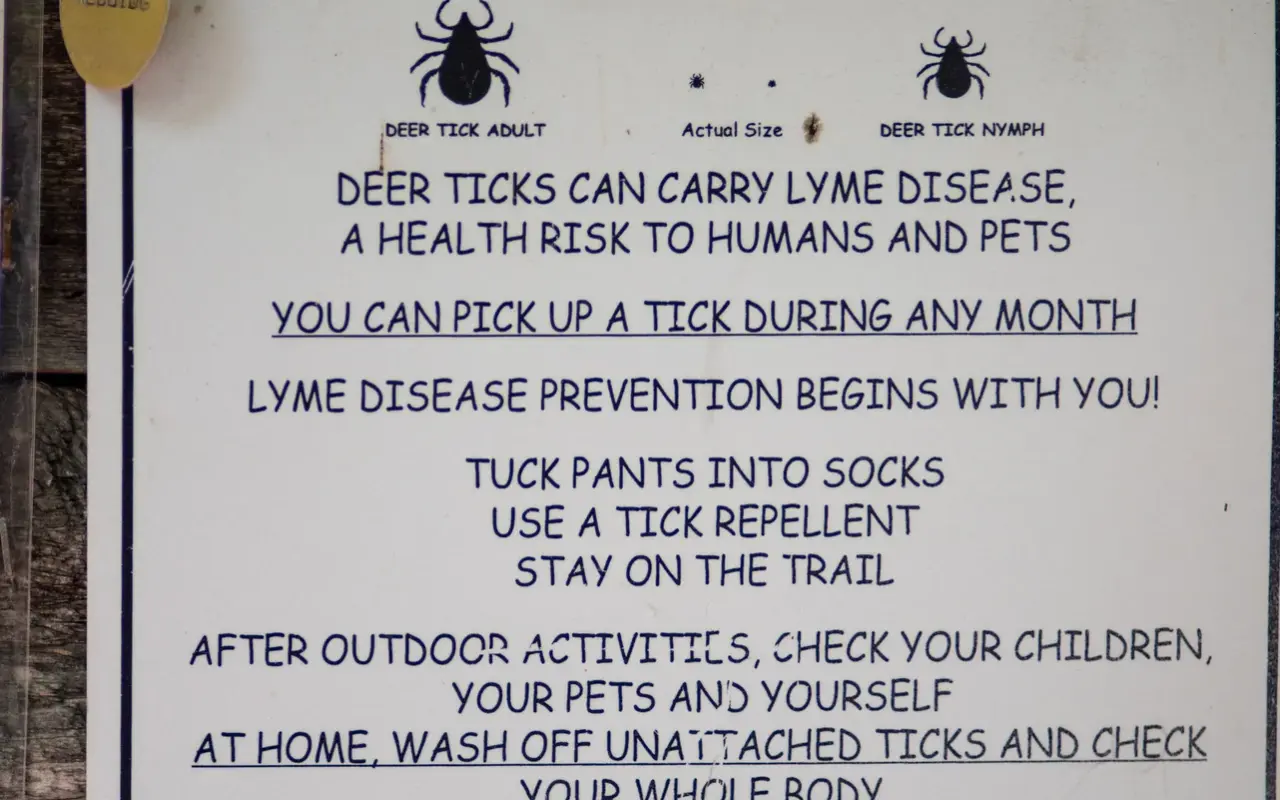
Island trails · preventionPhoto by MV Vacation
A trailhead sign with the short version: tuck pants into socks, use repellent, stay on the trail, and check everyone afterward.
Tick country · dense brushPhoto by MV Vacation
Dense island brush like this is tick country, with deer ticks questing at about knee height. Walking the middle of the trail and treating your cuffs both help.
Island-wide · tick controlPhoto by MV Vacation
A common summer sight outside island homes: an Oh Deer crew treating a yard against ticks and mosquitoes.
Island experts agree that personal protection is the part you control, and that permethrin-treated clothing is the most effective single step.
For repellents, the CDC recommends EPA-registered products with DEET, picaridin, IR3535, oil of lemon eucalyptus (OLE), para-menthane-diol (PMD), or 2-undecanone. Look for the EPA registration number on the label; the EPA's online repellent finder shows how many hours each product protects against ticks, so you can match it to the length of your walk. Apply and reapply as the label says, and if you also wear sunscreen, it goes on first. Don't use OLE or PMD on children under three; for babies and toddlers, the label and your pediatrician are the guide.
Permethrin is different: it goes on clothing and gear, never on skin (the CDC suggests products with 0.5 percent permethrin). A home spray, applied until the fabric is damp and then left to dry, lasts about six washings or six weeks depending on the label; factory-treated clothing lasts longer, and Insect Shield's send-in service is rated for up to 70 washings. Start with shoes, socks and pants, since ticks climb up from the ground. The Martha's Vineyard Tick Program lists a 15 percent Insect Shield discount code for 2026, MARTHASV2026, on its Prevent the Bite page. One caution from the same page: keep cats away from permethrin until it has dried.
Beyond chemistry, the old-fashioned measures still help. Wear light-colored clothing so ticks show up, tuck long pants into your socks, choose closed shoes over sandals, and stick to the center of trails. When you get home, shower within two hours, and tumble-dry your clothes on high heat for at least 10 minutes (the island tick program says 15 to be safe). If they need washing first, use hot water: cold and warm washes don't kill ticks.
A tick check, every time
Ticks head for warm, hidden spots, so those are where you look: behind the knees and under the arms, in and around the ears, the belly button, the waistband and groin, between fingers and toes, and all through the hairline and scalp. Check children and pets the same way: dogs bring ticks indoors, where they can find you next.
Around the house
If you live here or you're renting a house for the season, the yard is worth a little effort. Clear leaf litter and cut back tall grass, lay a three-foot band of wood chips or gravel between the lawn and the woods to slow ticks crossing over, keep play equipment and firewood away from the tree line, and fence out deer where you can.
Islanders get the material at John Keene Excavation, 25 Old Stage Road in West Tisbury (508-693-5975, Monday to Friday 7:30 AM to 4:30 PM, Saturday 8 to noon, closed Sunday). On the price list effective May 1, 2026 (updated August 14), island wood chips are $13 a yard picked up or $22 a yard delivered for five to ten yards, 3/4-inch gray gravel is $77.75 a ton, and a clean pickup-truck load of brush from the clearing costs $75 to dump there; the brush dump is closed Tuesdays and Thursdays. Prices change with the season, so call before you go.
For a yard-sized job rather than a truckload, Jardin Mahoney at the corner of Edgartown-Vineyard Haven Road and County Road in Oak Bluffs (508-693-3511, open every day 9 to 4 as of October 2026) sells it bagged, with cedar bark and hardwood mulch stacked by the pallet, with flatbed carts by the door and prices on the signs above each stack. A three-foot band around a small lawn takes more bags than you think, so count the run before you load the cart.
Oak Bluffs · a garden centerPhoto by MV Vacation
A garden center yard in Oak Bluffs: mulch and soil by the pallet along the shed, a flatbed cart ready, and the trees and shrubs out back under the oaks.
If you find a tick, take it off right away
The CDC's advice is to remove an attached tick as soon as possible instead of waiting to have it done at a clinic, because the delay itself can raise the risk of infection. The island tick program says the same thing more gently: don't panic, but get it off. The doctor comes after that, if the tick was swollen with blood or you start to feel unwell, and the island now has same-day options built for this (see the clinics below).
Disclaimer:The information in this section is based on personal experience and public CDC guidance. It is not medical advice, nor is MV Vacation liable for outcomes resulting from DIY tick removal. Always consult a doctor if you're concerned about a tick bite or symptoms.
What we've learned from experience (not medical advice)
Islanders use the CDC's method. Grasp the tick with fine-tipped tweezers as close to the skin as you can (plain tweezers or even fingers will do in a pinch; just don't squeeze its body), and pull straight up with steady, even pressure, without twisting or jerking. Clean the bite and your hands with soap and water, rubbing alcohol or hand sanitizer afterward, then seal the tick in a zip-lock bag or wrap it in tape rather than crushing it. Keeping it lets you or a clinician see what kind of tick it was and whether it was swollen with blood, and those two things decide what happens next. Watch the site for the next few weeks for a rash, fever, or flu-like symptoms.
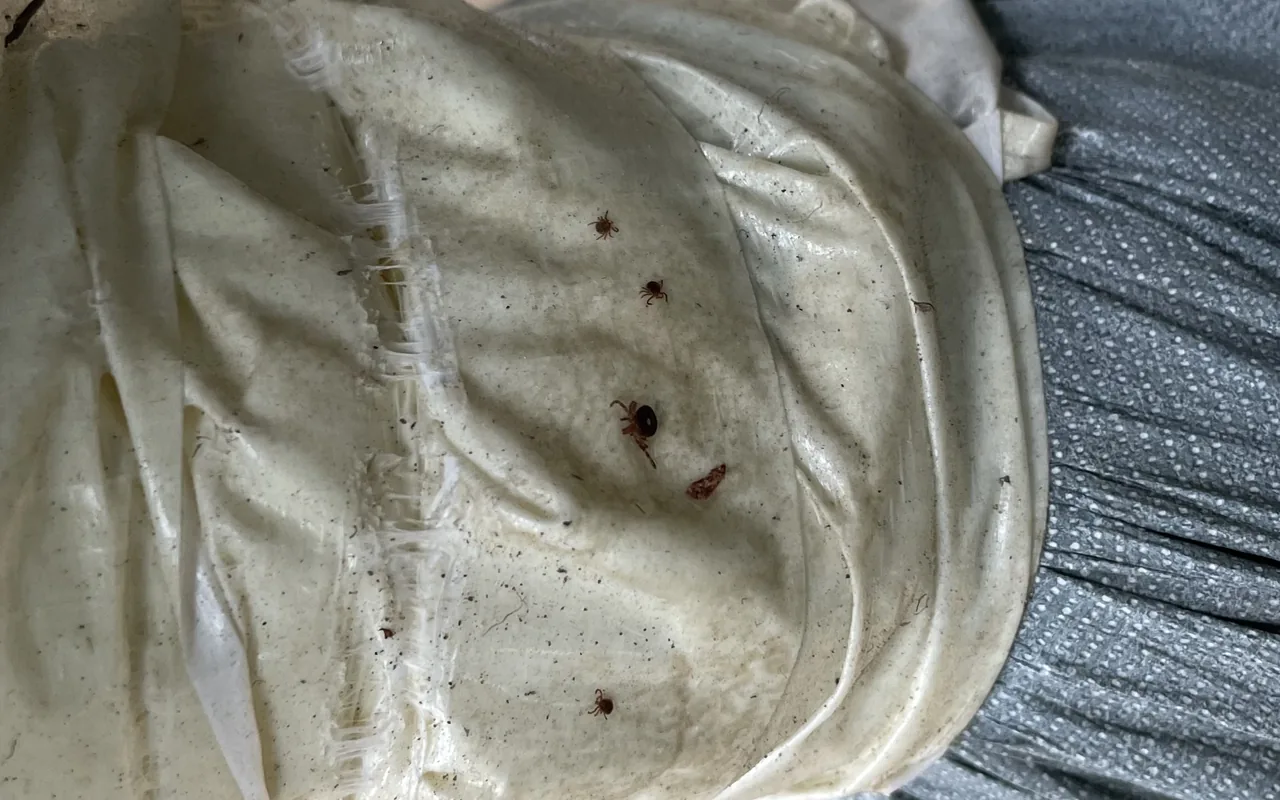
People who work in the brush have a trick worth copying: wrap a band of wide tape, sticky side out, around your ankles or over your boot covers before you go in. Ticks climb upward and stick to it, and you can count what you would otherwise have carried home. Four in a few hundred yards of Aquinnah scrub, in the photo below, is a normal afternoon.
After a walk · the tape checkPhoto by MV Vacation
Ticks caught on a band of tape wrapped sticky side out over boot covers, a cheap way to see what the walk left on you.
What not to do: don't burn the tick or smother it with petroleum jelly, nail polish, or essential oils. Those old tricks can make it worse. Don't twist or crush it. And if part of the mouth stays behind, try once more with the tweezers; if it won't come out easily, leave it alone, and the skin will push it out as it heals.
If you walked into a tick bomb (the late-summer larval clusters, hundreds of specks the size of sand grains, usually on the feet and ankles), the island routine is quick and unglamorous: strip outside or in the bathroom, run every piece of clothing through a hot dryer before it is washed, get into a hot shower and scrub, and go over the skin under a bright light. A lint roller or a band of tape lifts the ones still crawling, one pass at a time; patience beats any spray. The larvae carry no disease, but the island health office is clear that their bites can still sensitize you to alpha-gal, and the itch can run a week. If a few rode home in the car or came into the house, the University of Rhode Island’s TickEncounter center says lone star ticks need damp air and usually dry out indoors within a few days to a couple of weeks, rarely long enough to reach their next life stage. Vacuum the seats and floor mats, and put blankets and car-seat covers through the same hot dryer. Skip the home potions: alcohol wipes and essential oils mostly send the ones you missed looking for a new host. Islanders who booked the hospital’s Express Care and Tick Clinic through the Patient Gateway drop-down report same-morning visits and, in bad cases, a prescription skin cream (a 5 percent permethrin cream is what several were given, spread head to toe, left on overnight, showered off in the morning, bedding washed). That is a clinician’s call, not ours. There is now a same-day door for it besides the emergency room.
When to call a doctor
Call a healthcare provider promptly if, in the weeks after a bite (the island tick program says to watch for 30 days), you develop a fever, an expanding red rash (the classic Lyme bull's-eye or any spreading patch), flu-like fatigue and body aches, or joint pain and swelling. Trouble breathing or swallowing after eating could signal an alpha-gal reaction and warrants immediate care. If a deer tick came off engorged (grey, plump, swollen with blood), a same-day call to a clinic is worth making: under CDC guidance a clinician may offer a single preventive dose of doxycycline, which has to be started within 72 hours of removing the tick. It lowers the risk of Lyme only, not of the other infections or alpha-gal, so it still pays to watch for symptoms, and antibiotics after every bite are not recommended. The island clinics and hospital can advise, and the hospital asks that you contact your primary care provider first unless it's a genuine emergency.
Island clinics, testing and local support
This is where the Vineyard has changed the most in the past year. Two tick-focused clinics have opened, alongside the existing programs. Every clinic, pharmacy and the hospital's hours are collected in our medical guide for visitors.
Where to get help
Where
Hours
How
Emergency department, Martha's Vineyard Hospital, 1 Hospital Road, Oak Bluffs
Open 24 hours, every day
Walk in or call 911; main line 508-693-0410
Express Care and Tick Clinic, at the hospital (Entrance 4)
Mon 8–4, Tue–Thu 8–5:30, Fri 8–4; closed weekends
Appointments only: 508-684-4500 or Patient Gateway
Martha's Vineyard Medical and The Tick Center, 364 State Road, Vineyard Haven
Mon–Fri 8–6, Sat 8–noon
Same-day and walk-in visits: 508-693-4400
Island Health Care, 245 Edgartown-Vineyard Haven Road, Edgartown
Mon–Thu 8–8, Fri–Sat 8–4; closed noon to 1 and Sundays
No walk-ins: call 508-939-9358 for a same-day slot
Mass General Brigham 24/7 Virtual Care
Any hour
Video visit for ages 3 and up while you are in Massachusetts; $130 self-pay
Hours change with the season, so a quick call before you drive is worth it. The Express Care hours are the ones published when it opened in June 2026.
Martha's Vineyard Hospital: Express Care and Tick Clinic
Opened June 15, 2026, at Wing 1 (Entrance 4) of the hospital, this appointment-only clinic (same-day or next-day slots by phone or the patient portal) was built specifically to handle tick bites and minor illness without tying up the emergency room. You don't need to be an existing hospital patient. Hours are Monday 8 a.m.–4 p.m., Tuesday through Thursday 8 a.m.–5:30 p.m., and Friday 8 a.m.–4 p.m., with virtual visits available; those are the hours published at its June opening, and it is closed on weekends. Book through the Mass General Brigham Patient Gateway portal or call the Patient Access Center at (508) 684-4500. By late August it had seen about 250 tick patients. The hospital has also bought the former Indian Hill Medical Center building on State Road in West Tisbury, which now houses its alpha-gal research center; the hospital has said the Express Care clinic will eventually move there too, so check the location when you book.
Martha's Vineyard Medical: The Tick Center
At 364 State Road in Vineyard Haven (formerly Vineyard Medical Care), this center opened in spring 2026 under medical director Dr. Gerald "Gerry" Yukevich. It focuses on long-term and chronic tick-borne illness and alpha-gal, combining standard clinical care (diagnosis, doxycycline prescribing) with integrative services and specialty lab testing through TickReport and Labcorp. The center's website now says it accepts most major insurance (at launch it was cash-pay, with a $350 first visit); confirm costs when you book at 508-693-4401. The center's own CEO describes its integrative offerings (acupuncture, nutrition, mindfulness) as "evidence-supported" rather than "evidence-based," so treat those as complements to, not replacements for, standard medical care.
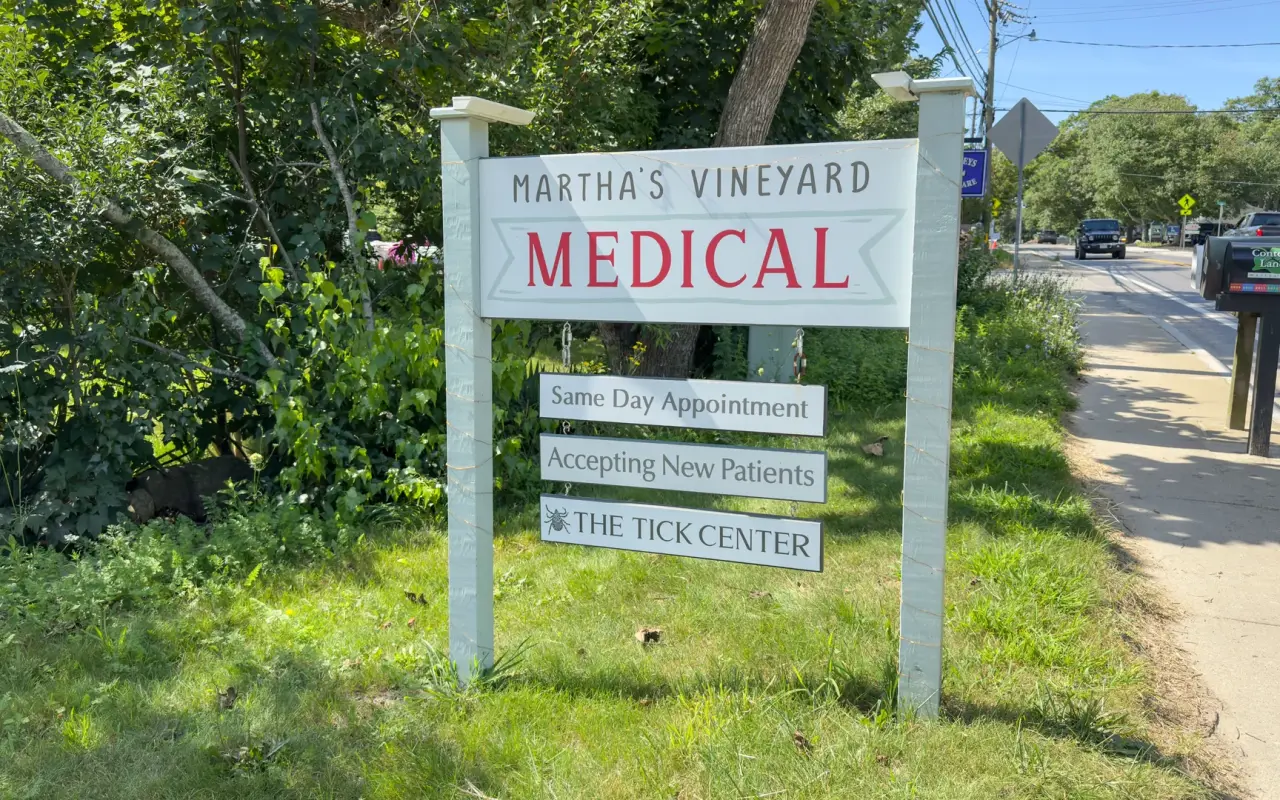
Vineyard Haven · The Tick CenterPhoto by MV Vacation
The roadside sign for Martha’s Vineyard Medical in Vineyard Haven, with Same Day Appointment, Accepting New Patients and The Tick Center on the boards below. It is the door for a bite that has you worried.
Island Health Care
A Federally Qualified Community Health Center at 245 Edgartown-Vineyard Haven Road in Edgartown, Island Health Care handles tick bites and tick-borne illness as a matter of routine and is open until 8 p.m. Monday through Thursday (8 to 4 on Friday and Saturday). It does not take walk-ins: call (508) 939-9358 and ask for one of the same-day slots, or choose option 3 to reach a nurse. It takes insurance and has a sliding-fee discount for people without it, the most accessible option if cost is a concern.
Tick identification and testing
Start with identification, which is free: the University of Rhode Island's TickSpotters service will identify a tick from a photo, and knowing the species tells you which illnesses to watch for. Testing the tick itself is optional, and the CDC generally advises against it: a positive tick doesn't mean you were infected, a negative one can falsely reassure, and symptoms usually show up before the results, so treatment shouldn't wait on it. If you still want it done, TickReport, a mail-in lab in Amherst, Massachusetts (tickreport.com), charges $60 for a basic DNA-only panel, $100 for its standard panel that adds viruses such as Powassan, and $200 for the most comprehensive one, with results within three business days of the tick's arrival; the lab says it knows of no insurance that covers it. For patients, the Massachusetts State Public Health Laboratory runs Powassan antibody testing that clinicians can order, with results in three to four days.
Programs and support
The Martha's Vineyard Tick-Borne Illness Reduction Initiative (the MV Tick Program), founded in 2011 and now directed by public health biologist Patrick Roden-Reynolds, offers education, residential yard surveys (mid-May through July, for a requested $50 contribution that is waived if it's a hardship), and research with Tufts and UMass. Its prevention pages, the tick activity calendar and the CDC's "Tick Bite Bot" decision tool live at islandspublichealth.com, and questions go to [email protected]. Tick Free MV, a nonprofit that formally launched in December 2025, is focused mainly on reducing the deer herd. There is also an Alpha-Gal Syndrome Support Group that meets the third Thursday of each month, 5–6 p.m., at the Up-Island Council on Aging, 1042 State Road in West Tisbury; the next meetings are October 15, November 19 and December 17.
Two Tufts studies are looking for island volunteers this fall. A five-year study of why some people recover from Lyme quickly while others feel ill for months enrolls patients who have the telltale rash, and Martha’s Vineyard Hospital, Martha’s Vineyard Medical and Island Health Care have been among its main recruiting sites. Separately, Dr. Sam Telford’s team is enrolling residents and long-time visitors who spend more than two months a year here for a short tick-bite survey and a small blood sample, with sign-up days on October 12 and 13; the times and places are on our events calendar.
Deer, and why the island is trying to thin the herd
Fewer deer means fewer ticks, and the Vineyard has a lot of deer. A drone survey commissioned by Tick Free MV and flown by White Buffalo between mid-February and mid-March 2026 counted 4,681 deer across the island's 87.7 square miles: about 53 per square mile, with hotspots in Aquinnah (101), Chilmark (85), and Chappaquiddick (62). For comparison, MassWildlife's statewide target is 12 to 18 deer per square mile. Tick Free MV wants to bring the herd down to roughly 1,500, about a 70 percent cull.
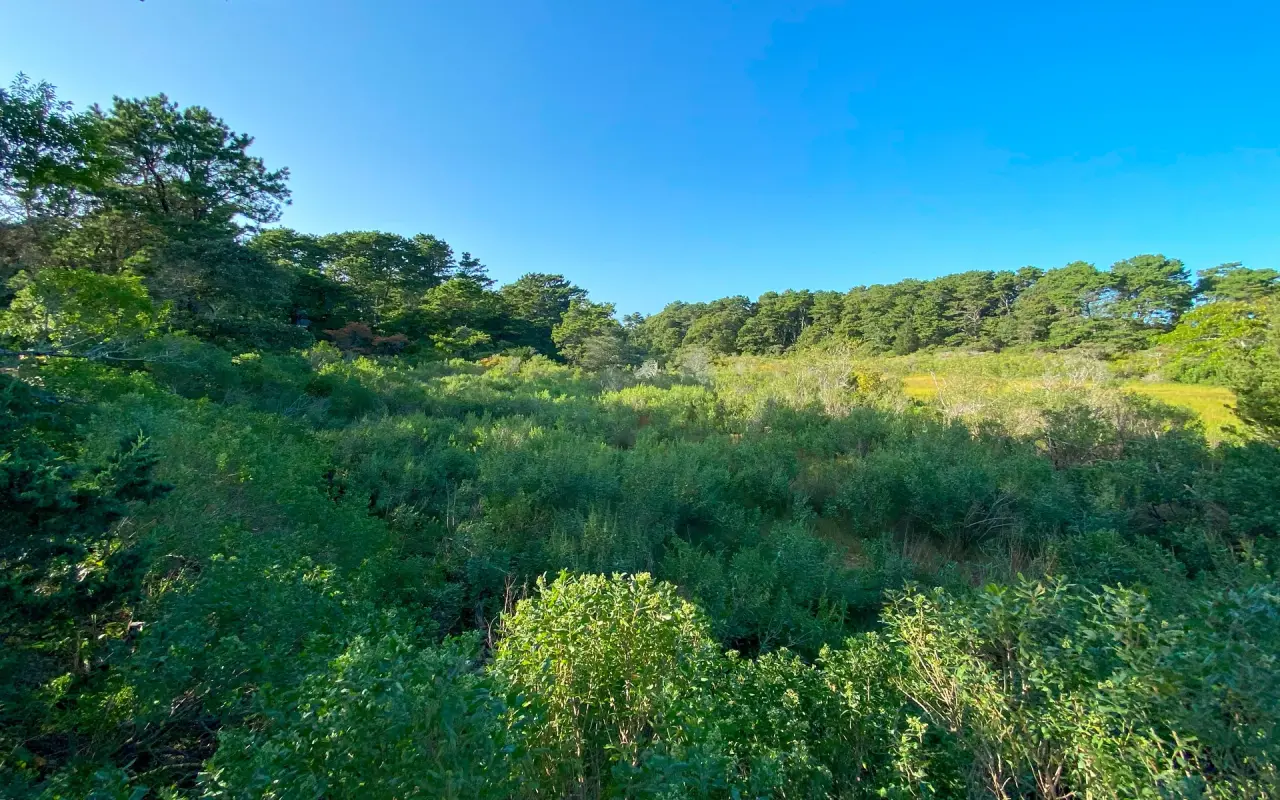
West Tisbury · the woodsPhoto by MV Vacation
Oak and pitch pine woods in West Tisbury, the cover the island’s 4,681 counted deer live in. The case for thinning the herd is that fewer deer means fewer ticks.
The state has stepped in. MassWildlife lengthened the island's hunting season, including an emergency extension into February: the 2025–2026 season (October 6 to February 15) brought in 934 deer, 329 of them in the added weeks, and the longer island season is now permanent. In April 2026 Governor Maura Healey filed legislation to allow Sunday hunting, expand crossbow use and shorten the bowhunting setback; as of the state's latest update, those changes still needed the Legislature's approval. She visited the island for a tick roundtable in June 2026, pledging state support for deer herd reduction, alpha-gal data collection, EpiPen access and permethrin distribution. Whether the cull moves the needle on tick numbers will take years to show, but it is the most aggressive response the island has mounted.
What's coming: vaccines and new prevention
The question we get most, whether there is a Lyme vaccine, finally has an answer on the horizon. On March 23, 2026, Pfizer and Valneva reported positive Phase 3 results for their six-valent Lyme vaccine candidate, with reported efficacy of about 73 to 75 percent in people aged five and up and a favorable safety profile. One caveat: fewer Lyme cases accrued in the trial than expected, and the pre-set statistical bar was met only on the second analysis, not the first, so these are company topline figures. In August 2026 the European Medicines Agency accepted the application and began its review; Pfizer has said it also plans to file in the United States. Until a regulator approves it, there is no Lyme vaccine you can get. No Lyme vaccine has been on the US market since LYMErix was pulled in 2002.
A different approach is also in the works. MassBiologics developed an anti-OspA monoclonal antibody that would give single-shot seasonal protection (not a vaccine: Tonix says protection would start within about two days) and in September 2025 licensed it to Tonix Pharmaceuticals, which plans a Phase 2 field study in the first half of 2027, pending FDA agreement.
On the ground, the record for tick-control technology is mixed. The corn-baited "4-poster" stations that roll permethrin onto deer were tested at sites on Cape Cod, Nantucket and the Vineyard, and the five-year study, led by EPA scientists, found tick numbers fell only about 8 percent at the spacing used. Spraying the whole island is impractical and ecologically risky, the island tick program says, and while spraying a yard can cut ticks in the treated area, the CDC's advice is not to rely on it. Scientists with the New England Center of Excellence in Vector-borne Diseases now hope to make Chappaquiddick a "living laboratory" for oral and topical tick-killing treatments given to deer. For the foreseeable future, repellent, permethrin-treated clothing and daily tick checks remain the best defense.
Tick activity by season
Edge habitat · tall grassPhoto by MV Vacation
Tall grass meeting brush, the classic edge habitat where ticks wait. Meadows like this are busiest from spring through fall.
The Martha's Vineyard Tick Program's activity calendar, built from field samples on the island, has no month without ticks. Season by season:
January–March: Adult deer ticks, out on any day above about 40°F. April–May: Adult deer ticks are still busy, deer-tick nymphs appear, and lone star and American dog ticks wake up. June–August: Peak season for deer-tick nymphs (May through July is the high-risk stretch for Lyme and the other deer-tick infections), plus lone star ticks at every stage and dog ticks. Lone star larvae, the "tick bombs," arrive in late summer. September: Nymphs slow down, lone star larvae are at their peak, and adult deer ticks come back. October–December: Adult deer tick season. Lone star larvae linger into October; after that it is mostly adult deer ticks, which stay active right through the winter whenever it is above about 40°F.
Visiting in October, November or December
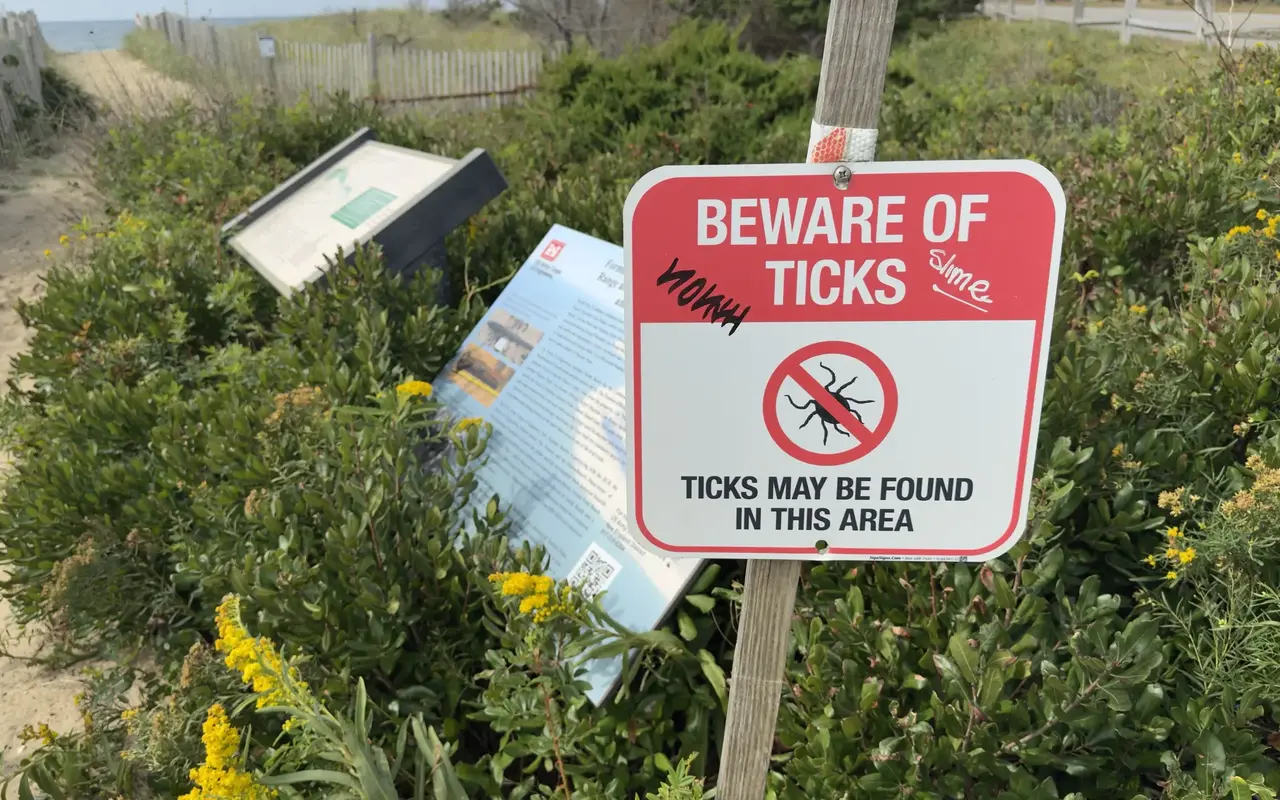
South Beach · a dune pathPhoto by MV Vacation
A Beware of Ticks sign on a dune path at South Beach in Katama, in low scrub with yellow wildflowers. Fall beach walks pass right through brush like this, and adult deer ticks are out in it from October on.
Fall is a lovely time to walk the island, and it is also adult deer tick season, so the summer habits still apply. Adults are about the size of a sesame seed rather than a poppy seed, so they are easier to spot and pull off early, and fewer kinds of ticks are out than in July. On the other hand, they wait in leaf litter, brushy edges and beach grass, exactly where fall walks go, and they can carry the same infections as the summer nymphs. Long pants tucked into socks feel natural in this weather, which helps; add permethrin-treated shoes and pants, a repellent, and a full check at the end of the day, dog included. One practical note for a weekend visit: the hospital's Express Care and Tick Clinic is a weekday service, so on Saturday the options are Martha's Vineyard Medical (8 to noon), Island Health Care (by phone, 8 to 4), virtual care at any hour, or the emergency room.
The short version
The woods and meadows are half the reason to come here, and ticks come with them. Most of the risk is in your hands: treat your clothes with permethrin, use a repellent, check yourself and your kids at the end of the day, and pull off anything you find right away. Know the early warning signs, and know that the island now has same-day clinics ready for a bite. Do that and you can walk every trail and beach here without thinking about it much.
Sources: CDC tick-prevention and repellent guidance; Martha's Vineyard Hospital 2025 Community Health Needs Assessment; Dukes County / Massachusetts Department of Public Health; Tufts University (Goethert et al., American Journal of Tropical Medicine and Hygiene, 2024; Telford); Johnson, Roden-Reynolds, Snow and Rich, Insects, 2024; Vineyard Gazette; Boston Globe; Pfizer/Valneva Phase 3 (March 2026) and EMA filing (August 2026); Martha's Vineyard Tick-Borne Illness Reduction Initiative and its tick activity calendar; Tick Free MV and White Buffalo aerial deer survey (2026); Martha's Vineyard Times. Re-checked October 2, 2026.
Nearly all year. Adult deer ticks move whenever it is above about 40 degrees, even in winter. The nymphs peak May through July, the highest Lyme risk of the year, and adult deer ticks are busiest from October into spring. Lone star ticks run mid-March through October, and their larval clusters, the tick bombs, show up from late July into the fall.
What is the best way to avoid tick bites?
Permethrin-treated clothing is the single most effective step, sprayed at home and left to dry, or bought pre-treated. Add an EPA-registered repellent such as DEET or picaridin, wear light colors, tuck pants into socks and stay in the center of trails. Shower within two hours and run clothes through a hot dryer for 10 minutes.
What should I do if I find a tick attached?
Take it off yourself right away with fine-tipped tweezers; the CDC advises against waiting for a clinic to do it. There is no safe window, and Powassan virus can pass in 15 minutes. Keeping the tick in a bag or on tape helps, and a call to a clinic makes sense if it was a deer tick swollen with blood or if you feel unwell later. The hospital's Express Care and Tick Clinic takes same-day appointments at (508) 684-4500. All clinic and pharmacy hours are in our medical guide.
What is alpha-gal syndrome?
An allergy to red meat and other mammal products, triggered by lone star tick bites. The reaction is delayed, usually two to six hours after eating: hives, stomach pain, trouble breathing, and in severe cases anaphylaxis. There is no cure. A positive test means sensitization, and only a portion of positives develop symptoms.
Do I need to check my kids and dog too?
Yes, every evening. Ticks head for warm hidden spots: behind the knees, under the arms, around the ears, the waistband and the hairline. Dogs carry ticks indoors, where they can find you next, so check them the same way. Our dog guide covers island rules for pets.
Are ticks active in October and November?
Yes. Fall is adult deer tick season on the Vineyard: the island tick program's calendar shows adults busiest from October into spring, and active on any day above about 40 degrees, even in winter. They are bigger and easier to spot than summer nymphs but can carry the same infections, so long pants tucked into socks, permethrin-treated shoes and a tick check after every walk still apply.
Should I get the tick tested?
Usually not. The CDC generally advises against it: a positive tick doesn't mean you were infected, a negative one can falsely reassure, and symptoms usually appear before the results. Free identification is more useful: send a photo to the University of Rhode Island's TickSpotters to learn the species and what to watch for. If you want a test anyway, TickReport in Amherst charges $60 to $200.
Can I get preventive antibiotics on the island?
Sometimes. If a deer tick came off engorged and you removed it less than 72 hours ago, a clinician may offer a single dose of doxycycline under CDC guidance; it lowers the risk of Lyme disease only. Call Island Health Care, Martha's Vineyard Medical or the hospital's Express Care and Tick Clinic, or use Mass General Brigham's 24/7 Virtual Care. Antibiotics after every bite are not recommended.
Island tip of the dayBeachesNo. 30 of 86New tip at midnight, island time
Owen Park Beach in Vineyard Haven is 2 minutes from the SSA ferry: calm harbor water, playground, dock. Perfect for a last-morning swim before departure.
Useful?
More on
Four free downloads · 2026 editions
Four island guides, in your inbox
The Beach Guide (all 20 beaches decoded), The Vineyard in the Fall, the season date by date, Where to Stay, every town and price band, and What It Really Costs, the 2026 budget line by line. All four PDFs free, plus a short island letter when there is something worth telling. No schedule, no spam.
No spam, unsubscribe in one click. Want a look first? See what you get.
First email ever from us? Give it a minute, and peek in spam once.
Disclaimer: The information in this article is provided for general guidance only and was accurate at the time of writing. Beach conditions, hours, prices, lifeguard schedules, ferry fares, and business operations change frequently and without notice. Ocean swimming carries inherent risks including rip currents, undertow, and cold water shock. Always verify current conditions with official local sources before your visit. MV Vacation assumes no responsibility for any loss, injury, or inconvenience resulting from the use of this information. Swim only where lifeguards are on duty, supervise children at all times near water, and follow all posted safety signs.
A guide to Martha's Vineyard, written on the island: beaches, dining, events and island living. We write down what we know about the island so your trip goes the way you hoped.
Shellfishing on Martha's Vineyard town by town: what each of the six towns charges a visitor for a permit and what it covers, where to buy it, weekly limits and sizes, the 2026 to 2027 bay scallop dates published so far, how to check storm and rain closures, and keeping the catch safe to eat.
Martha's Vineyard's ponds explained: the great ponds sealed behind the south-shore beach and cut open to the sea by an excavator, the salt ponds with tides and scallops, the freshwater kettle ponds, why cyanobacteria blooms turn some of them green in August and what MV Cyano's colors mean, the nitrogen under the houses, and where a visitor can swim, paddle and watch the cut.
Where Martha's Vineyard's oysters, bay scallops and quahogs come from: the public solar hatchery on Lagoon Pond that turned fifty in 2026, the dozen oyster farms in Katama Bay, Menemsha Pond and Vineyard Sound, the wild beds in the great ponds, the autumn scallop season and its limits, visitor shellfish permits by town, why rain closes a pond, and where to eat them.
Mytoi, the Japanese garden on Chappaquiddick: how to get there on the Chappy ferry, the 15-car lot, hours and admission by season, the pond and bridge, birch walk and camellia dell, the story of Hugh Jones, Mary Wakeman and the rebuild after Hurricane Bob, rules, accessibility and when to go.
Felix Neck Wildlife Sanctuary in Edgartown: the four easy trails and what each passes, the ospreys, the butterfly garden, hours and admission, Mass Audubon's kayak tours and prices, accessibility, the Wampanoag and Smith-farm history, and when to go.
Every hiking trail on Martha's Vineyard: 220+ miles across 114 properties. Menemsha Hills, Cedar Tree Neck, Felix Neck, Aquinnah, and tick safety tips.
Subscribe
The free island library · 2026
One short island letter, and all four guides to start
Beach reports, events worth a day, ferry heads-ups. Sent when there is something worth telling. The Beach Guide, The Vineyard in the Fall, Where to Stay and What It Really Costs arrive with your welcome email.
The Beach Guide, The Vineyard in the Fall, Where to Stay and What It Really Costs. No spam, one-click unsubscribe.
We use cookies for trip planning, site stats and ads, including ads based on your browsing. To opt out, turn on Global Privacy Control in your browser. Cookie policy
These cookies are essential for the website to function properly.
These cookies help us understand how visitors interact with the website.
These cookies are used to deliver personalized advertisements.