By MV VacationUpdated 08 Oct, 202613 mins read 279 views
The rules visitors break on Martha's Vineyard, sorted into state law, town bylaw and plain custom: speed limits and one-way streets, bike lights and sidewalks, beach regulations and fines, dog rules by town, noise hours, boat sewage, shellfish permits, and the manners that mark a guest from a tourist.
When visitors get something wrong on Martha's Vineyard, it's usually a mainland habit on an island that runs on a different clock, with a short list of rules that are enforced. Some of those rules are state law, some are town bylaws with real fines on the sign, and some are simply how things are done here. Below, each rule says which kind it is, and where it comes from a bylaw or a statute, which one.
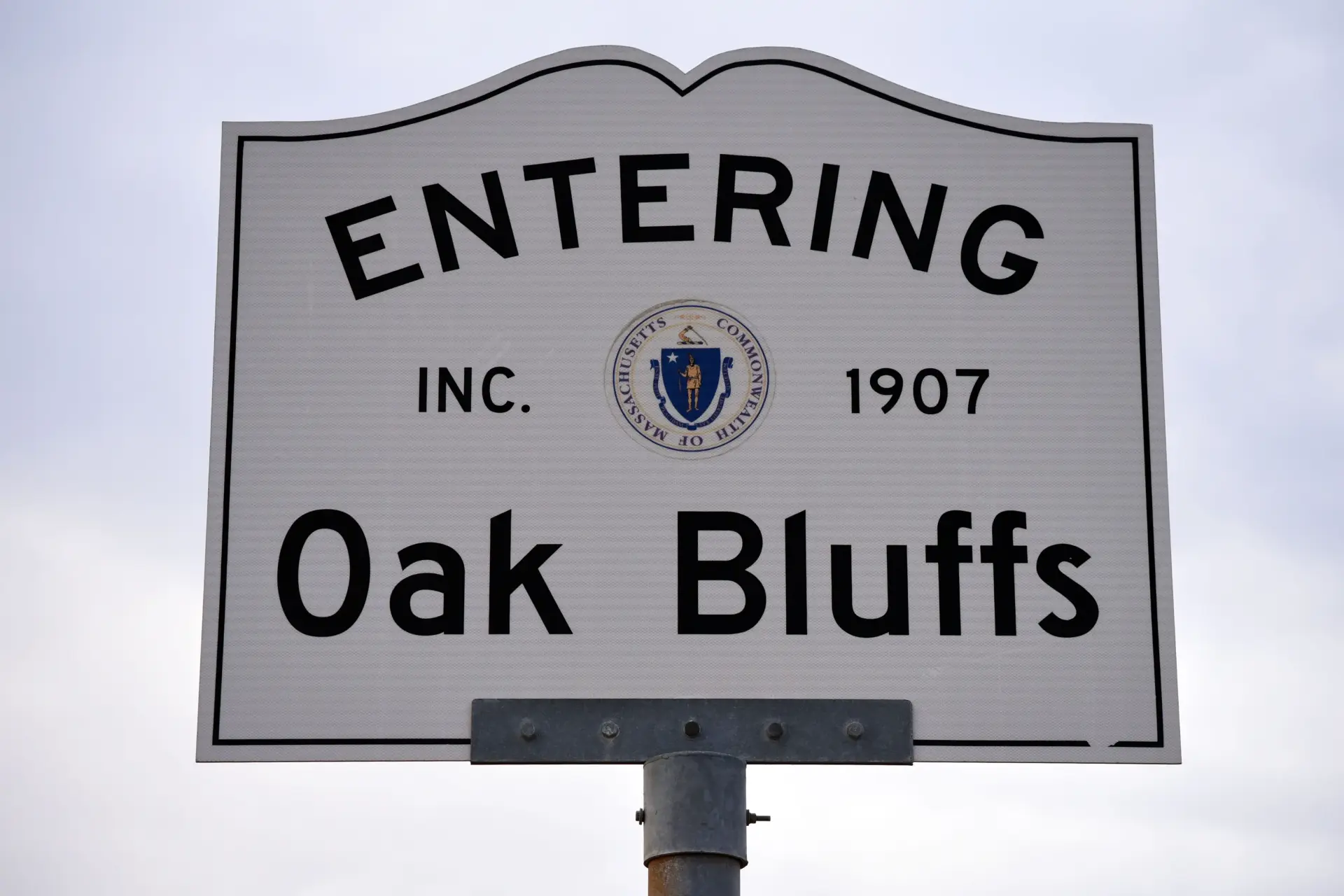
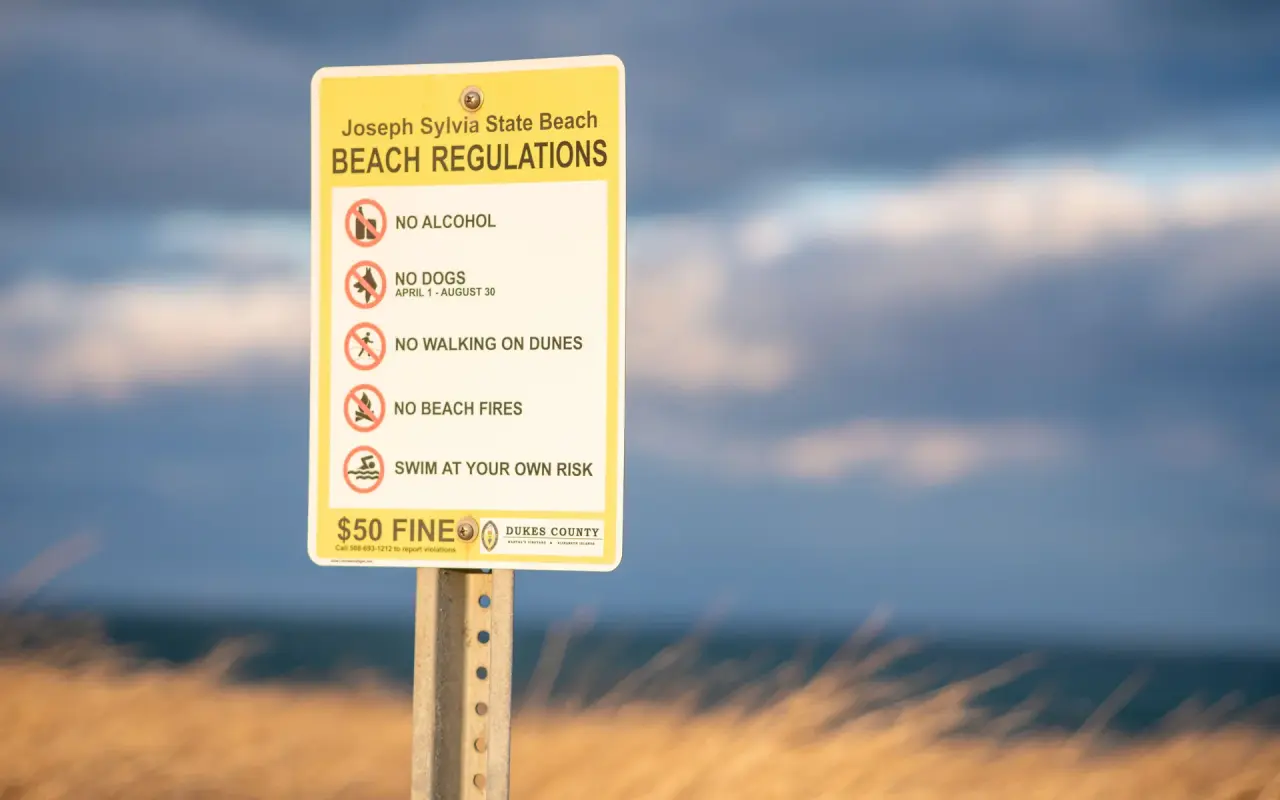
Oak Bluffs · Joseph Sylvia State BeachPhoto by MV Vacation
The county's regulations board at State Beach: no alcohol, no dogs in season, no walking on the dunes, no fires, and a fifty-dollar fine for any of it.
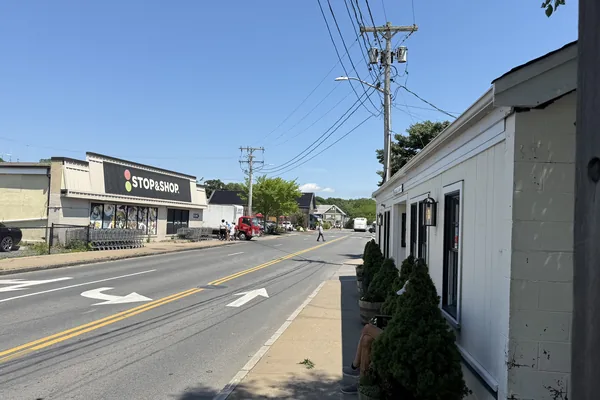
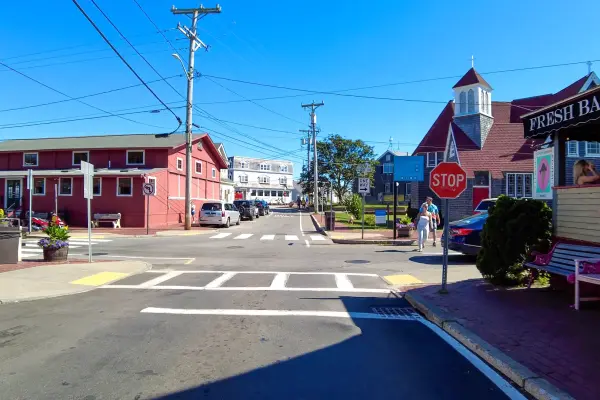
Nothing on the island is posted above 45 miles per hour. The Edgartown to West Tisbury road, the Edgartown to Vineyard Haven road and the airport stretch of Barnes Road are the fast ones, and even there the limit drops without much warning at the town lines. Down-island town centers are 20 or 25. There are no traffic lights anywhere on the island, so intersections work on courtesy and the four-way stop, and the locals will wave you through before you have finished thinking about it.
The narrow streets in the three down-island centers are one-way. They were laid out in the nineteenth century for carriages, and Edgartown in particular is a grid of one-way lanes that will send you in a full loop if you miss a turn. The arrows are a better guide than the map app, which sometimes lags a block behind. Our parking guide covers where you can leave the car once you get there.
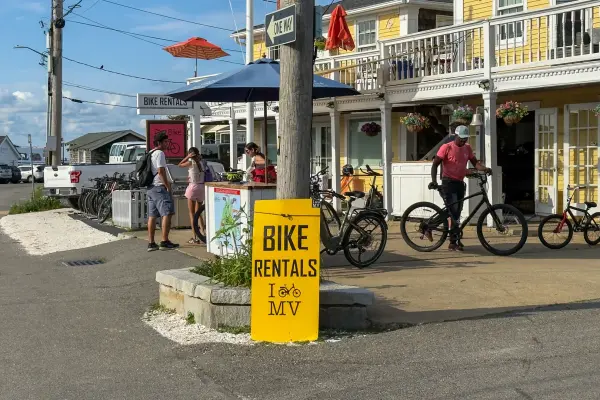
Bicycles go on the road or the paths, and off the downtown sidewalks. Massachusetts law allows a bike on a sidewalk only outside a business district, and only when it is safer than the road. In the centers of Edgartown, Oak Bluffs and Vineyard Haven that means walking the bike. Electric bikes are not allowed on any sidewalk. The shared-use path network connects the down-island towns and is the reason you do not need the sidewalk in the first place.
Riding after dark needs a real light. From half an hour after sunset the state requires a white headlight visible from 500 feet and, at the back, both a red light and a red reflector. A reflector on its own does not satisfy the law. Rental shops will supply lights if you ask when you pick the bike up, and it's worth asking, because the up-island roads have no street lighting at all.
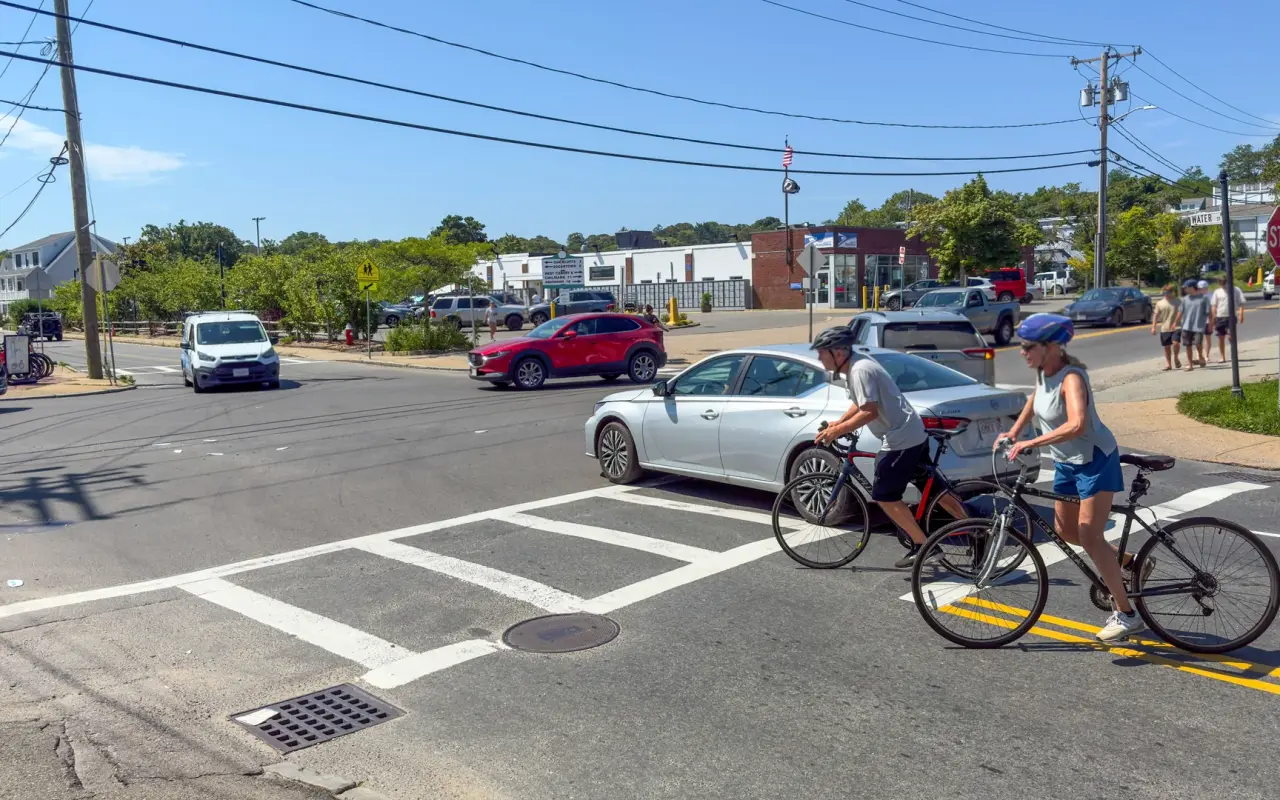
Vineyard Haven · Five CornersPhoto by MV Vacation
Five Corners in Vineyard Haven on a summer day. Bikes, cars and pedestrians share one junction with no signals.
On the beach: the posted rules
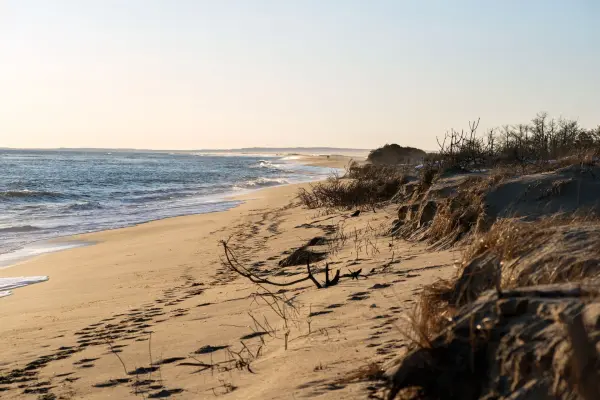
Every town beach and every county beach has a regulations board at the entrance, and people patrol to enforce them. The one at Joseph Sylvia State Beach, the long stretch between Oak Bluffs and Edgartown, is typical: no alcohol, no dogs from April 1 to August 31, no walking on the dunes, no beach fires, and swim at your own risk. The fine printed on that sign is 50 dollars. Rules differ from beach to beach, so the sign at the one you are standing on is the one that counts. Our beach guide lists the dog, lifeguard and parking rules for each beach.
The dunes are off limits. The grass on them is what holds the beach together, and a season of shortcuts kills it, so the boardwalks and marked cuts are the way through. Where a section is roped off for nesting piping plovers, usually from spring into July, the closure is federal, and walking through it is a very expensive mistake.
Beach fires are rare. The county beaches and the Trustees properties prohibit them outright. Where a town allows a fire at all, it is by permit from that town's fire department, and the permit will tell you where and how. A fire ring on the sand doesn't mean a fire is allowed there.
Sleeping on the beach or in your car isn't allowed. Beach camping is banned in all six towns, the conservation lands close at dusk, and downtown parking is cleared overnight. The only legal way to sleep outdoors on the island is the campground in Vineyard Haven, which we cover in the camping guide. If your ferry is late and your bed is gone, that guide also has the fallbacks.
Shellfishing needs a permit. Clams, quahogs, oysters and scallops in the ponds belong to the town whose water they are in, and each town sells its own recreational permit; most also sell visitors a week or month permit, though Oak Bluffs, Chilmark and Aquinnah sell those only from May through September. Digging without one, or taking from a closed area, is treated seriously because the beds are managed year to year. The town hall or shellfish department of the town you're in can sort you out.
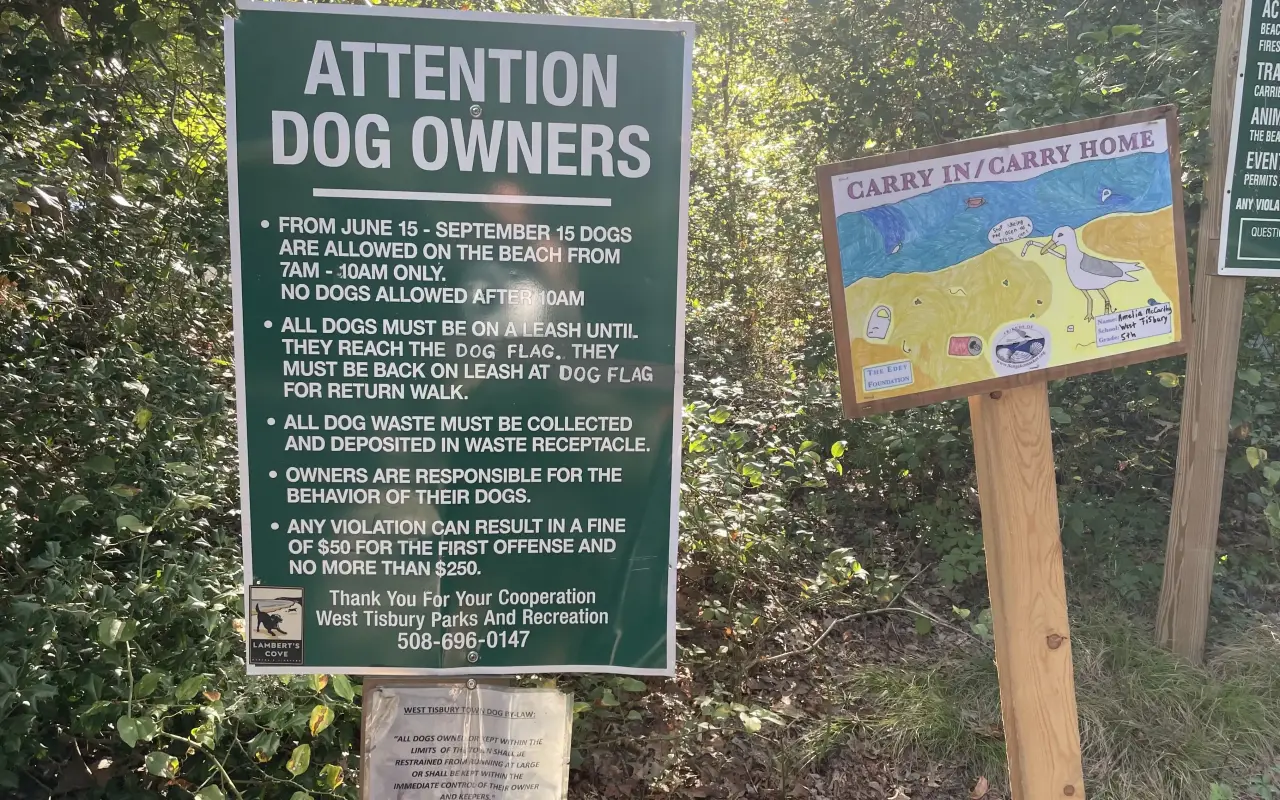
West Tisbury · Lambert's Cove BeachPhoto by MV Vacation
Lambert's Cove: dogs from 7 to 10 in the morning between mid-June and mid-September, on a leash until the flag, fifty dollars the first time you ignore it.
For beach days
The Beach Guide, free
All 20 beaches with parking, stickers, lifeguards and dog rules, plus a one-page card for the beach bag. Free with the island letter, together with three more island guides.
One-click unsubscribe, and we never share your email.
Dogs: six towns, six sets of rules
There is no island-wide leash law. Each town has its own dog bylaw, and the beaches inside each town have their own seasons and hours on top of that. West Tisbury's bylaw requires every dog to be restrained or under the immediate control of its owner, and at Lambert's Cove in summer that means the beach is open to dogs only between 7 and 10 in the morning, on a leash until the dog flag. Tisbury keeps dogs off all of its beaches year-round. Oak Bluffs allows them on the town beach early and late in the day in summer. The conservation groups differ too: the Land Bank welcomes dogs on most of its trails, Sheriff's Meadow wants them leashed, and Felix Neck and the Trustees properties at Long Point and Mytoi do not allow them at all. Bags help, and where a sign says no dogs, it's enforced. The dog guide has the beach-by-beach detail.
Oak Bluffs · a rules signPhoto by MV Vacation
A rules board in Oak Bluffs: no dogs, and no bikes, skateboards, roller blades or scooters.
Towns after dark: the noise bylaws
This is the rule visitors break most often, and the one that generates the most police calls in July. Oak Bluffs prohibits disruptive noise after 11 at night, and Edgartown and West Tisbury draw the line at 10. The houses in the down-island centers sit a few feet apart with the windows open, and the person you are keeping awake may have a boat to run at five. A rental party that carries on past the bylaw hour gets a visit, and repeated visits have cost people their booking. Music inside and conversation at porch volume keep the peace, and on the walk back from a bar in Oak Bluffs or Edgartown the houses along the street are full of people trying to sleep.
On the water
All of the coastal waters of Massachusetts are a federal No Discharge Area, which means no boat may pump sewage overboard, treated or not, anywhere around the island. Every harbor has a pumpout boat or a dock station, and in most of them the service is free. Environmental police and harbormasters can issue penalties of up to 2,000 dollars per violation, and they do check. The same harbormasters manage the moorings and the launch ramps, and what gets you a mooring in August is plain courtesy: calling ahead and asking nicely. Announcing who you are doesn't help here.
In the woods and on the trails
The Land Bank, Sheriff's Meadow, the Trustees and the state forest between them hold thousands of acres open to the public, and their rules are short: stay on the marked trails and carry out what you carry in. No drones on Land Bank land, which the commission banned outright, and no amplified music. Low-impact foraging such as picking berries is allowed on Land Bank properties, but nothing gets uprooted or dug, and the rare plants of the sandplain are protected by state law wherever they grow. Hunting happens on some properties in autumn under separate rules, so something bright is a good idea on a November walk.
Ticks are the island's one real hazard. Long pants on grassy trails, a check every evening and a look at our tick and Lyme guide before walking in tall grass take care of most of it.
A trailhead · the tick noticePhoto by MV Vacation
A tick notice at a trailhead, with an adult and a nymph shown at actual size and a reminder that you can pick up a tick in any month.
What is custom, not law
Nobody will fine you for any of the following, but they are how the island tells a visitor from a guest. (For the words themselves, up-island, wash-ashore, the boats, see our island glossary.)
On the road · fall colorPhoto by MV Vacation
A Slow, Children sign under the fall maples: one of the most common roadside requests on the island.
In the town centers people wear shirts and shoes. A swimsuit on Main Street in Edgartown or on Circuit Avenue stands out, and most shops and every restaurant will send you back for a shirt.
Trash goes home with you. The island's trash leaves by ferry, which is why bins are scarce on beaches and trails and why the carry in, carry out signs are everywhere.
At the four-way stops, islanders wave and let the other driver go. People drive slowly here and let others in, and the ferry won't leave early because you got to the dock first.
Fame doesn't get you far. The island has had famous summer residents for a century and treats them like everyone else. Dropping a name to get a table, a mooring or a delivery slot doesn't work; patience and a thank-you do.
Tips matter here. Most of the people serving you in July are students on four-month visas working for tips; here is who they are.
Many farm stands run on the honor system, with a box for the money, and the system only lasts because people pay.
Summer kitchens are busy. In July and August a takeout or delivery order routinely takes half an hour or more, and a table without a reservation means a real wait. Ordering before you're hungry helps, a pickup timed against a ferry rarely works, and the person at the counter, usually a student on a four-month visa, is doing their best.
Up-island especially, what people have paid for is quiet. Fireworks, drones, bluetooth speakers on the beach and leaf-blower-hour lawn parties are all resented in the same measure.
The American Legion Memorial Bridge on Beach Road, the one from the film, has signs against jumping for a reason. We say more about that in the Jaws tour post, and we do not tell anyone to do it.
Alcohol, rides and other practical rules
Only Chilmark is still fully dry, and four of the six towns have no package store, which changes where you can buy a bottle and whether a restaurant can serve you a drink; the dry towns guide explains the map and the BYOB customs. Drinking on the beach is banned at State Beach, South Beach and Norton Point, as the State Beach sign shows, and the posted rules at each entrance cover the rest. If you have been drinking, the bus is free (the last summer runs leave around 10 or 11 PM depending on the route, and the off-season timetable ends earlier), and the rideshare and taxi guide is honest about how hard a late ride is to find up-island.
At a glance
Rule
Where it comes from
What happens
Top speed 45 mph, less in town
Posted limits, state traffic law
Ticket; police patrol the 45 zones in summer
Bike lights after dark
Massachusetts General Laws c. 85 s. 11B
Citation; and the road is dark
No bikes on downtown sidewalks
State law, business districts
Told to walk it; citation if you argue
No alcohol, fires, dogs in season, dunes
County and town beach regulations
50-dollar fine at State Beach; varies by beach
No sleeping on beaches or in cars
Town bylaws, all six towns
Moved on; fines and loss of beach access
Noise after 10 pm (11 in Oak Bluffs)
Town noise bylaws
Police visit; repeat calls end rentals early
Shellfish without a permit
Town shellfish regulations
Fine and confiscation
Boat sewage overboard
Federal No Discharge Area
Up to 2,000 dollars per violation
Drones on Land Bank land
Land Bank policy
Asked to land it; banned outright
Swimsuits on Main Street
Custom
Looks, and a shop that will not serve you
How we checked this
The beach rules are read directly off the regulation boards in our own photographs, taken at State Beach and Lambert's Cove. The bicycle lighting and sidewalk rules are from Chapter 85, Section 11B of the Massachusetts General Laws. The noise hours are as reported by the Vineyard Gazette from the town bylaws. The No Discharge Area and the 2,000-dollar penalty are from the Massachusetts Environmental Police enforcement notice. Dog policies are from the Land Bank and each town's published rules. Bylaws change at town meeting every spring, so if a sign on the ground disagrees with this page, the sign wins, and we would like to hear about it.
Frequently Asked Questions
What is the speed limit?
Nothing on the island is posted above 45 mph, and only on a few stretches; the down-island town centers are 20 or 25. There are no traffic lights anywhere, so intersections work on courtesy and the four-way stop, and the down-island centers are grids of one-way lanes laid out for carriages.
Can I ride a bike on the sidewalk?
Not in the centers of Edgartown, Oak Bluffs and Vineyard Haven: Massachusetts law allows sidewalk riding only outside a business district, and electric bikes never. The shared-use paths connect the towns so you do not need the sidewalk.
Do I need bike lights?
Yes, by law, from half an hour after sunset: a white headlight visible from 500 feet and both a red light and a red reflector at the back. A reflector alone does not satisfy it. Rental shops supply lights if you ask; up-island roads have no street lighting.
Which rules are law and which are custom?
Some are state law, some are town bylaws with real fines on the sign, and some are simply how things are done. This guide separates the three and says where each rule comes from.
What about the beach?
Every town beach posts its rules at the entrance, and they're enforced. The beach section on this page lists what gets you fined, from dogs and fires to alcohol and where you can and cannot drive.
Island tip of the dayShoppingNo. 31 of 86New tip at midnight, island time
The Chappy Ferry costs $5/person round-trip and $17 for a car with driver. Cards work at the Edgartown-side kiosk; bring cash for the boat itself.
Useful?
More on
Four free downloads · 2026 editions
Four island guides, in your inbox
The Beach Guide (all 20 beaches decoded), The Vineyard in the Fall, the season date by date, Where to Stay, every town and price band, and What It Really Costs, the 2026 budget line by line. All four PDFs free, plus a short island letter when there is something worth telling. No schedule, no spam.
No spam, unsubscribe in one click. Want a look first? See what you get.
First email ever from us? Give it a minute, and peek in spam once.
Disclaimer: The information in this article is provided for general guidance only and was accurate at the time of writing. Beach conditions, hours, prices, lifeguard schedules, ferry fares, and business operations change frequently and without notice. Ocean swimming carries inherent risks including rip currents, undertow, and cold water shock. Always verify current conditions with official local sources before your visit. MV Vacation assumes no responsibility for any loss, injury, or inconvenience resulting from the use of this information. Swim only where lifeguards are on duty, supervise children at all times near water, and follow all posted safety signs.
A guide to Martha's Vineyard, written on the island: beaches, dining, events and island living. We write down what we know about the island so your trip goes the way you hoped.
Solo travel on Martha's Vineyard: the $11 walk-on ferry and the bus from Boston, the $40 hostel and B&Bs with breakfast, the free bus and $30 bikes, the $20 church lobster roll, the free concerts, dock dances and community sing where you meet people, the small-group tours, five solo days and the honest safety notes (ticks, currents, the last bus).
The cheapest way to get to Martha's Vineyard: walk onto the Steamship Authority at Woods Hole for $22 round trip, every other boat ranked by fare (Island Queen $30, Seastreak $55 same-day, Hy-Line $78), what Woods Hole parking and the Boston bus cost, the car question in dollars and the cheapest route from Boston, the Cape, Rhode Island and New York.
What to do if you get sick or hurt on Martha's Vineyard: the one hospital and its 24-hour emergency department, the new Express Care and Tick Clinic, the walk-in practice in Vineyard Haven, Island Health Care's evening hours, 24/7 virtual care for $130, the island's three remaining pharmacies (no CVS, no 24-hour counter, Leslie's closed), bus and taxi access, and travel insurance for visitors.
Every supermarket and market on Martha's Vineyard with posted hours: Stop and Shop, Cronig's, Reliable Market, Alley's, the meat and fish markets, the Falmouth Stop and Shop before the ferry, Instacart and pre-stocking delivery, and an honest word on island prices.
MV on a budget: hostel $40/night, the fare-free VTA bus, $20 Grace Church lobster rolls, free beaches, and how to do a full week for about $1,050.
Subscribe
The free island library · 2026
One short island letter, and all four guides to start
Beach reports, events worth a day, ferry heads-ups. Sent when there is something worth telling. The Beach Guide, The Vineyard in the Fall, Where to Stay and What It Really Costs arrive with your welcome email.
The Beach Guide, The Vineyard in the Fall, Where to Stay and What It Really Costs. No spam, one-click unsubscribe.
We use cookies for trip planning, site stats and ads, including ads based on your browsing. To opt out, turn on Global Privacy Control in your browser. Cookie policy
These cookies are essential for the website to function properly.
These cookies help us understand how visitors interact with the website.
These cookies are used to deliver personalized advertisements.